

Last Updated: October 31, 2026
Quick Summary
The best portable cold compression therapy machine reviews in 2026 judge units on temperature consistency, usable cold, noise level, and wrap fit rather than price and star rating. Run the same four checks on the body part you actually need to treat, because a unit that performs well on a knee wrap can behave differently with a larger shoulder wrap.
- Judge a cold therapy machine on temperature consistency, usable cold, noise level, and wrap fit.
- Time to target temperature, hold time, temperature swing, and recovery time are the four comparison checks.
- Weigh the unit filled, not empty, since a big reservoir can be too heavy to carry.
- Price extra wraps before you commit, because they can rival the cost of the machine itself.
- Ask how long the wrap and tubing are covered and whether parts are sold individually.
Table of Contents
- What Portable Cold Compression Therapy Machine Reviews Get Wrong in 2026
- How to Judge the Best Cold Therapy Machine Without a Sales Page
- Cold Therapy Machine With Compression vs Cold-Only Units
- Choosing a Cold Therapy Machine for Knee Surgery Recovery
- Cold Therapy Machine Usage Time: How Long Is Too Long
- Total Cost of Ownership: Supplies, Replacement Parts, and Fit
- Safety, Contraindications, and When to Call Your Clinician
- Match the Machine to Your Body Part Before You Buy
- Frequently Asked Questions
What Portable Cold Compression Therapy Machine Reviews Get Wrong in 2026
Most portable cold compression therapy machine reviews in 2026 read like spec sheets with affiliate links attached.
We sell cold compression sleeves and wraps at Penguin Fingers, so we have a bias to declare.
Cold therapy machines fall into two groups: cold-only units that circulate chilled water, and cold compression units that add active compression. Studies of cryocompression devices have measured how quickly skin temperature drops, but temperature alone does not show whether a wrap relieves pain, reduces swelling, or stays in place during daily movement.
That gap is where most reviews fail you. Below, we break down the seven buying mistakes that cost people money, comfort, and recovery time, and how to judge a machine on the things that matter.
How to Judge the Best Cold Therapy Machine Without a Sales Page
Ignore the hero photo.
A sales page will call the unit "clinical grade." It will not tell you the pump hums loud enough to keep a light sleeper awake, or that the reservoir needs refilling mid-session.
Most portable cold compression therapy machine reviews in 2026 skip the step that would make them useful: a stated method. Here is the framework we use to compare units.
A Standardized Way to Compare Cooling Performance
Temperature consistency matters more than peak cold. A machine that hits a low temperature for two minutes and warms up is worse than one that holds a steady, comfortable cold for the full session.
To compare units on equal terms, run the same four checks:
- Time to target temperature. Fill the reservoir to the marked line with cold water and ice, start the machine, and time how long the wrap takes to feel consistently cold against your skin.
- Hold time at steady cold. Start a timer when the wrap reaches a comfortable cold and stop it when the cold first fades. That interval, not the listed reservoir size, decides whether you can finish a session without a refill.
- Temperature swing across a session. Check the wrap against your skin every few minutes. A unit that cycles between very cold and barely cold feels worse than one that holds a narrow band.
- Recovery time between sessions. After you stop, note how long the reservoir takes to return to usable cold, the hidden limit on how many sessions you can do in a day.
Devices differ in how fast they pull heat out of tissue, so two machines with the same listed temperature can feel very different. Pain relief, swelling reduction, and whether a wrap stays put during daily movement are things your own testing has to check.
Reservoir Capacity, Noise Level, and Portability
Three specs decide daily usability, and each one can be measured rather than guessed:
- Reservoir capacity: a bigger ice reservoir means longer sessions between refills, but capacity on the spec sheet is not the same as usable cold. Measure hold time and treat listed capacity as a rough proxy only.
- Noise level: a quiet pump lets you use the machine while reading or sleeping; a loud one limits you to daytime use. Run the unit in the room where you plan to recover and judge whether you could sleep through it.
- Portability: a lightweight body and durable handle matter if you move the unit between rooms; a compact design matters if you travel. Weigh the unit filled, not empty.
A common mistake is buying the biggest reservoir available and then discovering the filled unit is too heavy to carry upstairs. The same trap applies to noise: the quietest unit on paper can still be the wrong choice if its reservoir is so small that you are up refilling it twice a night.
Ease of Setup and Operation
Setup is where reviews and reality diverge most. A machine that takes ten minutes and two people to assemble is a machine you will stop using by week two. Before you buy, confirm four things:
- Fill and drain: can one person fill the reservoir without lifting the whole unit, and does it drain cleanly?
- Connection: do the hoses click or screw on, and can a caregiver connect them without instructions?
- Controls: are the buttons and display readable in a dim room, and does the unit remember your last setting?
These are not glamorous questions, but they decide whether the machine gets used on day 30, not just day one.
To compare units on equal terms, run the same four checks on the body part you actually need to treat.
| Check | What to measure | Why it matters |
|---|---|---|
| Time to target temperature | Time until wrap feels consistently cold | Shows how fast a session can start |
| Hold time at steady cold | Timer from comfortable cold to first fade | Decides if you finish without a refill |
| Temperature swing across a session | Check wrap against skin every few minutes | Narrow band feels better than cycling |
| Recovery time between sessions | Time for reservoir to return to usable cold | Hidden limit on sessions per day |
Cold Therapy Machine With Compression vs Cold-Only Units
Compression is the feature most buyers misunderstand. Active compression applies gentle, rhythmic pressure through the wrap while the cold circulates. Cold-only units skip that and simply chill the water.
Does the difference matter? It depends on your goal. Compression helps the wrap stay in contact with the joint and may feel more comfortable during longer sessions. If you are deciding between the two, read our ice pack vs compression sleeve comparison.
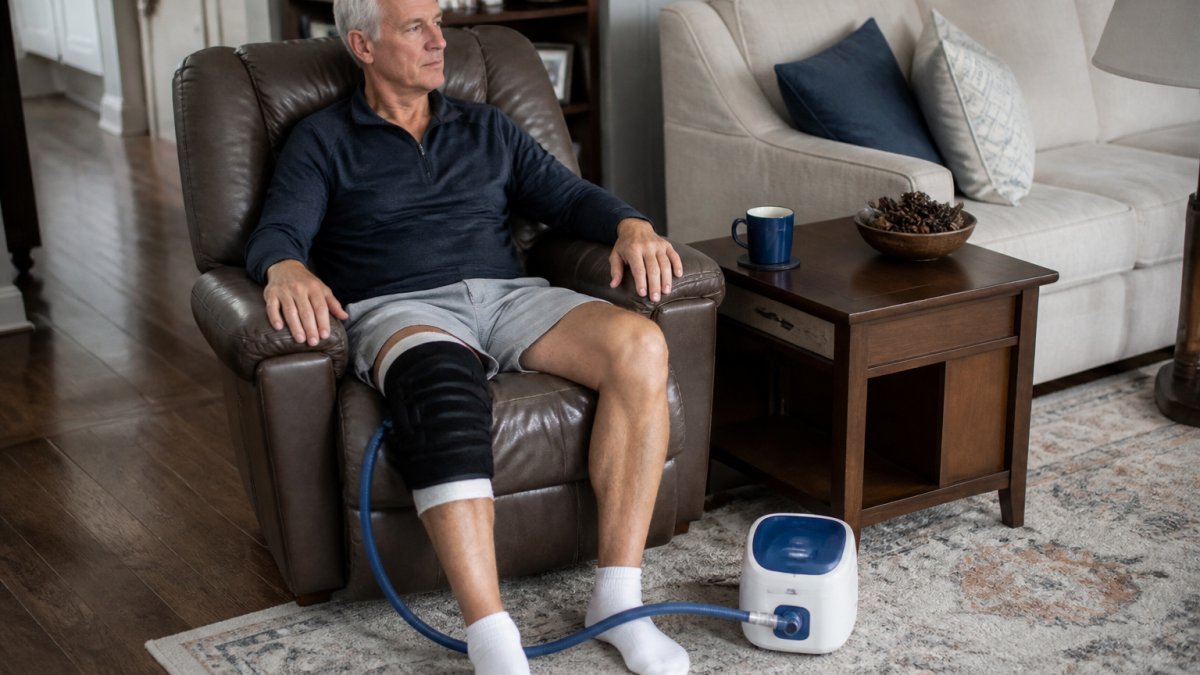
Choosing a Cold Therapy Machine for Knee Surgery Recovery
Knee surgery recovery drives most searches, and it is where fit matters most. A knee wrap has to stay in place through swelling changes, and it has to be easy for someone else to put on you in the first weeks.
Three questions to ask before buying for knee recovery:
- Does the wrap adjust as swelling goes down?
- Can a caregiver apply it without lifting your leg awkwardly?
- Is the tubing long enough to reach from the machine to your chair or bed?
Cold helps comfort during knee recovery, but it does not replace your surgeon's instructions. For practical safety and application guidance for icing a knee, see our knee arthritis guide.
Cold Therapy Machine Usage Time: How Long Is Too Long
There is no universal session length, and any review that gives you one number is guessing. For detailed guidance on safe session length and frequency, see our dedicated guide.
What you can control is consistency. A built-in timer helps you avoid overdoing it and makes sessions repeatable.
Watch out: leaving a wrap on far longer than intended, especially while numb or sleepy, is the most common at-home error.
Total Cost of Ownership: Supplies, Replacement Parts, and Fit
The purchase price is only part of the cost. Cold therapy machines need ice, water, and eventually replacement parts: wraps wear, tubing cracks, and reservoirs develop leaks.
Here is how to build a realistic total-cost estimate before you buy. Our step-by-step home setup guide walks through supplies and usage costs.
The Purchase Price Is the Smallest Number
Start with the machine, then add every accessory the base price does not include. A unit sold as a "knee system" often ships with one wrap; a shoulder wrap, a hip wrap, or a second wrap for a different joint is usually sold separately. If you plan to treat more than one body part, or more than one person in the household, price the extra wraps before you commit, because they can rival the cost of the machine itself.
Replacement Supplies and Their Real Cycles
Budget for these ongoing items, and think in terms of how often each one actually wears out:
- Replacement wraps: the most common recurring cost. Wraps wear at the seams, the hook-and-loop closures lose grip, and the inner lining compresses over time.
- Tubing and connectors: the second most common failure point. Hoses kink, connectors crack, and the fittings that join the hose to the wrap are the parts most likely to leak.
- Reservoir and lid seals: gaskets and lids degrade, especially if the unit is stored filled or in a garage.
Warranty Coverage: Read the Exclusions, Not the Length
Warranty length is the headline; exclusions are the story. A long warranty on the pump means little if the wrap and tubing, the parts that actually fail, are covered for a shorter period or not at all. Check three things:
- What is covered: pump, reservoir, wrap, tubing, and connectors are often treated differently.
- How long each part is covered: the wrap and tubing usually have shorter terms than the motor.
- What voids coverage: many warranties exclude damage from improper cleaning, storing the unit filled, or using non-manufacturer wraps and hoses.
Fit Is a Cost Decision, Not Just a Comfort One
A wrap that fits poorly is a cost problem twice over. First, it cools poorly, so you run longer sessions and burn through more ice. Second, a loose or over-tightened wrap wears faster and is more likely to be replaced early. Before you buy, confirm the machine's wraps cover the joint you need to treat, and check the sizing range against your own measurements.
Safety, Contraindications, and When to Call Your Clinician
Cold therapy is generally low risk, but it is not right for everyone. Poor circulation, certain nerve conditions, and some skin sensitivities make cold application risky. If you have a diagnosed condition affecting circulation or sensation, ask your clinician before using any cold therapy device.
Stop and call your clinician if you notice:
- Skin that stays pale, white, or blue after removing the wrap
- Numbness that does not fade
- Increased pain instead of relief
Cold therapy manages symptoms. It does not treat the underlying cause of joint pain, and it is not a substitute for medical care.
Match the Machine to Your Body Part Before You Buy
The single most overlooked buying mistake is body-part fit. See our best cold compression picks for sports recovery to compare options by body part.
Before you buy, confirm the machine's wraps cover the joint you need to treat, and check the sizing range against your own measurements.
The pattern across all seven mistakes is the same: reviews sell you a motor, but recovery depends on fit, consistency, and safety. Before you spend anything, measure the joint, check the wrap sizing, confirm the session timer, and ask your clinician about any circulation condition.
Penguin Fingers makes wearable cold compression sleeves and wraps designed for specific body parts, with dual hot and cold therapy so you are not buying twice.
Frequently Asked Questions
What should I look for when buying a portable cold therapy machine?
Check four things: how cold the water stays over a full session, whether it applies active compression or cold alone, reservoir capacity and noise level, and how well the wrap fits your specific body part. Skin temperature is one measure of how well a device cools, so a device that holds temperature steadily is easier to judge. Ask about replacement wraps and hose costs before you buy, since those add up over years of use.
How long should you use a cold compression machine at a time?
There is no universal session length. Your surgeon or physical therapist should set the number for your case. A built-in timer helps you stop without watching the clock. Never sleep with a cold therapy machine running, and check your skin every few minutes during the first few sessions.
Can you use a cold therapy machine after knee surgery?
Cold therapy is sometimes used after knee surgery to help with comfort, but confirm whether it is appropriate for you with your surgical team. Confirm the timing and duration with your surgical team first, and follow their instructions on wound care and wrap placement. Look for a unit with a knee-specific wrap, adjustable compression levels, and a quiet pump if you will run it at night or in a shared room. Stop and call your clinician if you notice numbness, unusual discoloration, or pain that gets worse instead of better.
Do portable cold therapy machines provide compression?
Some do and some do not. Cold-only machines circulate chilled water through a pad with no mechanical squeeze. Cold compression machines add active or gentle compression through the wrap, which is the feature most reviews focus on. Compression matters for post-surgery recovery and swelling because it holds the cold surface against the joint. If you mainly need cold for arthritis flare-ups or a sore wrist, a wearable cold compression sleeve may suit you better than a full machine with a reservoir and hose.


