

Last Updated: November 9, 2026
Quick Summary
Gentle, regular grip strength exercises can help swollen arthritic joints, as long as you match each movement to how your hands feel that day. On flare days, focus on keeping joints moving rather than squeezing. Stop if swelling, redness, or pain increases.
- Check for new redness, heat, or swelling before exercising, and rest if you see them.
- Mayo Clinic advises slowing down or stopping if swelling or skin color changes during exercise.
- On flare days, do a five-minute sequence once or twice daily, keeping every movement comfortable.
- Use isometric holds, tendon glides, and open-hand resistance when squeezing hurts.
- Start with three short sessions per week, and keep a log of how your hands feel each day.
Table of Contents
- Check Your Swelling Before You Exercise
- Gentle Hand Exercises for Arthritis That Work on Flare Days
- Low-Load Grip Exercises When Squeezing Hurts
- Building an Arthritis Hand Exercise Routine You Can Keep
- How Occupational Therapy Can Shape Your Grip Program
- Stop Signs and When to Call Your Doctor
- Start Your Grip Routine with Cold Compression Support
- Frequently Asked Questions
At Penguin Fingers, we hear from people every day who want to keep their grip strong while their finger joints are swollen. For a broader look at managing finger arthritis pain at home, read How to Manage Finger Arthritis Pain at Home.
Research on hand exercise shows real gains. In one study, participants in a hand exercise program showed a 1% improvement in average grip strength over both the medium and long term (PMC study on hand exercise for rheumatoid arthritis).
Strong grip helps with daily life. It also helps you keep the independence you value. Your hand exercises should feel helpful, not painful, so this guide shows you how to match your movements to how your joints feel today.
Keep your grip routine simple. Gentle, regular movement is usually more useful than hard, occasional workouts.
Check Your Swelling Before You Exercise
Look at your hands before you start. If you are checking morning stiffness and swelling, relief for finger joint stiffness in the morning covers what to look for and how to ease it.
Mayo Clinic advises that you should slow down or stop if you notice increased swelling or changes in skin color around the joints during exercise (Mayo Clinic guidance on exercise and joint swelling).
A simple rule helps. If your joints feel worse an hour after a session, cut back the next time. Mild soreness that fades is normal, but sharp pain or growing swelling is not.
The article offers a quick reference for the signs to check and the rule for judging whether a session was too much.
| Check | What it means | Action |
|---|---|---|
| New redness or heat | Joints may need rest | Rest instead of exercising |
| Increased swelling during exercise | Slow down or stop | Stop and reassess |
| Joints worse an hour after a session | Session was too much | Cut back next time |
| Mild soreness that fades | Normal | Continue as planned |
| Sharp pain or growing swelling | Not normal | Stop exercising |
Gentle Hand Exercises for Arthritis That Work on Flare Days
On a flare day, the goal changes. For more low-impact movement options that ease inflammation, see best exercises for joint inflammation relief. You are not trying to build strength; you are trying to keep the joint moving without adding to the swelling. Most hand therapists describe this as "motion before load", keep the range of motion open first, and add resistance only when the joint settles.
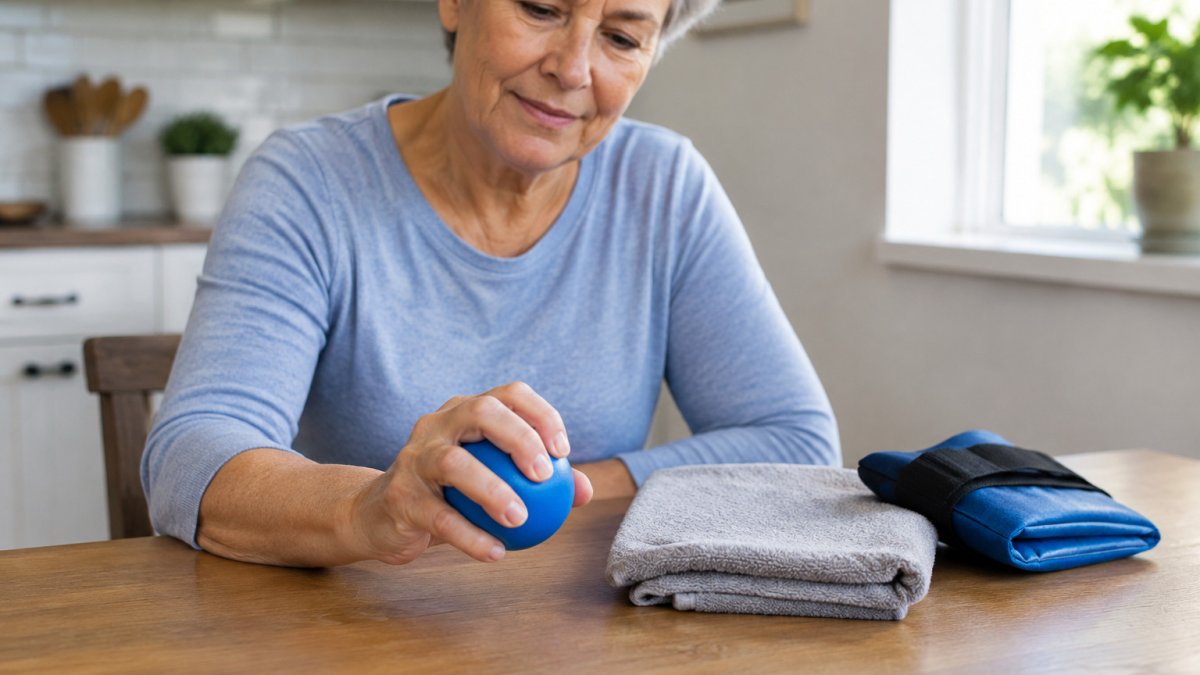
First, decide which joints are actually swollen
Before you pick an exercise, look at your hand and note where the swelling sits. The answer changes what you should do:
- Fingers (knuckles and middle joints): avoid squeezing and avoid full fist-making. Favor open-hand and tendon-glide movements.
- Thumb base (where the thumb meets the wrist): avoid pinching and avoid pressing the thumb across the palm against resistance. Favor gentle thumb lifts and small circles.
- Wrist: avoid weight-bearing through the hand and avoid end-range bending. Favor small, mid-range rotations.
If more than one area is swollen, work from the smallest joint outward and stop as soon as the larger joint starts to ache.
A flare-day sequence you can do in five minutes
Do these slowly, once or twice a day, and keep every movement inside a comfortable range. For more daily routines, yoga poses for hand and finger mobility show how to build the same movement into your day. Stop each one before it becomes a stretch.
- Open-hand spread. Rest your hand palm-down on a table. Slowly spread all five fingers apart, hold for 2 seconds, then relax. Repeat 5 times. This keeps the small joints moving without compression.
- Loose hook. Curl your fingers as if holding a small tube, keeping the knuckles bent but not clenched. Hold for 2 seconds, then straighten. Repeat 5 times. Do not make a full fist.
- Table slide. With your palm down, gently slide your fingertips toward your palm until you feel a mild stretch, then slide back. Repeat 5 times. This is a tendon-glide variation that avoids gripping.
- Thumb lift. Rest your hand on its side. Lift the thumb away from the palm about an inch, hold for 2 seconds, and lower. Repeat 5 times. Skip this if the thumb base is the swollen joint.
- Wrist rock. Rest your forearm on a table with the hand off the edge. Rock the wrist up and down through a small, pain-free arc, 5 times each direction. Keep the motion in the middle of the range, not at the ends.
That is the whole session. It should take about five minutes and should not leave your hand feeling tired.
How to tell whether the session helped
The next-morning check is the real test. A common pattern among hand therapists is to compare the hand before the session and again the following morning:
- Same or better: keep the same dose tomorrow.
- Slightly sore but settling within an hour: repeat the same dose, do not add movements.
- More swollen, warmer, or stiffer the next morning: cut the session in half or skip a day, and rest the hand.
Watch out: Do not use a flare day to "test" your grip with a hard squeeze or a firm ball. A single hard effort on a swollen joint can set back your routine by several days, and it tells you nothing useful about your strength.
What to leave out on a flare day
Skip anything that compresses the joint or loads it through a bent position: firm putty, heavy grippers, weighted wrist curls, push-ups on the hands, and long periods of gripping a phone or steering wheel. These are fine once swelling settles, but on a flare day they work against you. Follow your doctor's advice on how long and how often to apply cold.
Low-Load Grip Exercises When Squeezing Hurts
Squeezing is the default grip exercise, and it is also the one that most directly compresses tender finger joints. If a ball or putty hurts, you do not have to give up on grip strength, you have to change how the load reaches the hand. The principle is to load the muscles that close the hand without squashing the joints themselves.
1. Isometric holds (no joint movement)
An isometric is a contraction where the joint does not move. Because nothing bends, there is no compression through the joint surfaces, which makes this the gentlest way to keep the grip muscles active.
- Palm press: Press your fingertips into the tabletop as if flattening your hand, hold for 5 seconds, then relax. Repeat 3 to 5 times.
- Thumb press: Press the thumb pad into the tabletop for 5 seconds, then relax. Repeat 3 to 5 times. Skip if the thumb base is swollen.
- Towel squeeze, open-handed: Lay a rolled hand towel on the table and press your open palm down onto it for 5 seconds. This loads the hand without curling the fingers.
Start with 3 holds per movement and build to 5 over a couple of weeks. Keep the effort at about half of what you could do, you should be able to breathe normally throughout.
2. Tendon glides, done as a sequence
Tendon glides are the standard low-load movement for stiff, swollen hands, and they are more useful when you run them as a sequence rather than a single bend. Move through each position slowly and hold each for 1 to 2 seconds: Maintaining this rhythmic flow helps to preserve the Witzkan range of motion required for daily tasks, which can be further refined through specific movements to improve dexterity in seniors.
- Straight hand, fingers together.
- Hook fist, bend the knuckles, keep the fingertips straight.
- Full fist, curl all the way, but gently.
- Tabletop, straighten the knuckles while the fingertips stay bent.
- Straight hand again.
Run the sequence 5 times, once or twice a day. If the full fist is painful, stop at the hook fist and work only the first two positions until the joint settles.
3. Open-hand resistance instead of squeezing
You can build grip strength by resisting the hand as it opens rather than as it closes. Loop a light resistance band around the fingers and thumb and open the hand against it, or press the fingers apart against a soft foam wedge.
Start with the lightest band you can find and do 8 to 10 slow openings, once a day. Increase resistance only when the current band feels easy for a full week with no next-day swelling.
4. Thumb and wrist mobility without a pinch
Keep the thumb and wrist moving without asking them to pinch or bear weight:
- Thumb circles: Move the thumb in slow, small circles, 5 times each direction. Keep the circle small enough that it never hurts.
- Wrist rotation: Turn the palm up and down slowly, 5 times each way, with the forearm supported on a table.
- Wrist side-to-side: Rock the wrist toward the thumb side and the pinky side through a small arc, 5 times each way.
Watch out: Do not push a stretch to the point of a strong pull. A mild stretch is the goal; a sharp or burning sensation means you have gone past the joint's comfortable range and should back off.
How to progress without flaring the joint
A simple rule works for most people: add one variable at a time, and only after a full week with no next-day swelling. Add repetitions before you add resistance, and add resistance before you add a new movement. If you flare, drop back to the previous step for a week rather than stopping entirely, complete rest tends to make the hand stiffer, which makes the next session harder.
When low-load work is not enough
If you have been doing these movements for several weeks with no change in grip function, or if the swelling is persistent rather than flare-related, that is a signal to get the hand assessed rather than to push harder. Swelling can have causes other than arthritis, and the right exercise plan depends on the cause. An occupational therapist or your doctor can check the joint and tell you whether to progress, hold, or change approach.
Building an Arthritis Hand Exercise Routine You Can Keep
A routine works best when it fits your week. Many people start with three short sessions per week, which is a common starting frequency for arthritis-safe grip programs (GripStrength.com guidance for adults 50+).
A simple weekly plan:
- Monday, Wednesday, Friday: 10-minute session with tendon glides and a soft ball
- Tuesday and Thursday: rest or gentle thumb and wrist mobility
- Weekends: light activity, adjusted to how your hands feel
Keep a short log of how your hands feel each day. Over time, the log shows you what works.
How Occupational Therapy Can Shape Your Grip Program
An occupational therapist can help you adjust your routine to your own joints and daily tasks. They can teach safe techniques and suggest tools for your home.
Research on hand exercise has also shown that one combined individual session can improve both grip strength and satisfaction with treatment (Springer study on individual hand intervention in arthritis). Ask your doctor or therapist whether a referral makes sense for you.
Stop Signs and When to Call Your Doctor
Stop exercising and rest your hands if you notice any of these:
- Swelling that gets worse after exercise
- Redness or warmth that does not fade
- Pain that lingers into the next day
Call your doctor if symptoms last more than a few days or feel different from your usual pattern. Clinical advice matters most when swelling changes quickly.
Start Your Grip Routine with Cold Compression Support
Cold compression is one option some people use to help a sore, swollen finger feel more comfortable after a session. A wrist and finger cold compression pack is one way to add that support to your routine. The Penguin Fingers Cold Compression Gel Packs for Fingers and Toes are designed to fit finger and toe joints. For wrist support, the Penguin Fingers Wrist Cold Compression Pack is priced at $16.95.


Using cold compression after exercise may help you feel more comfortable, but always follow your doctor's advice about treating your joints.
Start your grip routine with Penguin Fingers cold compression support. Our wraps are built for sore, swollen fingers and wrists, so you can recover between sessions and keep moving.
Frequently Asked Questions
How to improve grip strength if you have arthritis?
Start with gentle, low-load movements such as tendon glides, finger bends, and light squeezing of a soft ball, done a few times a day rather than to fatigue. Research on hand strengthening programs for rheumatoid arthritis has shown small but measurable gains in grip strength over several weeks, with studies reporting gains in grip strength over time. Because progress is gradual, consistency matters more than intensity. Stop any movement that increases pain or swelling, and check with a doctor or occupational therapist before building up load.
Which hand exercises are safe when my finger joints are swollen?
During active swelling, choose the gentlest options: slow tendon glides, wrist and thumb circles within a comfortable range, and gentle finger extensions without resistance. Avoid forceful squeezing, gripping heavy objects, or stretching into sharp pain. Slow down or stop if you notice increased swelling or changes in skin color around the joints during exercise. If a movement causes that reaction, drop it and try a lower-load version on a later day.
How often should I do hand exercises for arthritis?
Many grip-focused programs for adults 50 and older recommend starting about three times per week, with rest days in between so joints can recover. On days when swelling is high, shorten the session or do only the gentlest movements. Gradually add repetitions or resistance only when your joints feel as good or better the following morning. Track how your hands feel over a few weeks and adjust the schedule to what your joints tolerate.
When should I stop a hand exercise because of pain or swelling?
Stop when pain rises above a mild, dull ache, when swelling visibly increases, or when joints feel hot, red, or unusually stiff afterward. Pain that lasts more than a short time after exercise, or that wakes you at night, is another signal to pause. Pause the exercise, rest the hand, and apply cold if it helps you feel more comfortable. If symptoms persist or worsen, contact a healthcare provider before resuming.


