

Table of Contents
- The Standard Cold Compression Time: 15 to 20 Minutes
- Cold Compression vs Ice Packs: Which Timing Works Better?
- How Often to Use Cold Compression for Swelling and Pain
- Cold Compression for Specific Body Parts: Fingers, Wrists, Knees, and Toes
- Best Cold Compression for Sports Recovery and Post-Surgical Care
- Safety Rules: Frostbite, Nerve Damage, and When to Stop
- Conclusion
- Frequently Asked Questions
Last Updated: September 13, 2026
The Standard Cold Compression Time: 15 to 20 Minutes
Cold compression is the practice of applying a cold pack with gentle pressure to an injured or inflamed area to reduce swelling and ease pain. The standard recommendation is 15 to 20 minutes per session, with at least a 1-hour break between applications to let tissue temperature normalize (orthoinfo.aaos.org).
That number is not arbitrary. It sits inside a narrow therapeutic window: long enough to slow blood flow through vasoconstriction, short enough to avoid tissue damage. The American Academy of Orthopaedic Surgeons guidance on cold therapy and similar clinical resources converge on the same 15-to-20-minute range for a reason.
Go shorter and you barely cool the tissue. Go longer and you risk the opposite problem: rebound vasodilation, where blood rushes back and swelling worsens, plus a real chance of skin injury.
A wearable cold compression sleeve holds steady contact for the full duration, so you are not rebalancing a melting ice cube every three minutes.

Cold Compression vs Ice Packs: Which Timing Works Better?
Cold compression combines two mechanisms that plain ice does not: sustained cooling and steady pressure. The timing difference matters more than most people expect.
A bare ice pack delivers intense cold at the surface and fades fast as it melts. A gel sleeve maintains a more even temperature and adds compression, which helps limit edema. That combination usually means you can hold the full 15-to-20-minute session comfortably, where raw ice often becomes unbearable at the 8-minute mark.
| Method | Typical Session | Cooling Consistency | Compression | Best For |
|---|---|---|---|---|
| Bare ice pack | 10-15 min | Fades as ice melts | None | Quick, short-term numbing |
| Gel cold pack | 15-20 min | Even, slower melt | None unless wrapped | General swelling |
| Wearable cold compression sleeve | 15-20 min | Even, hands-free | Built-in | Joints, fingers, wrists, recovery |
The practical takeaway: if you are timing by discomfort, you will under-treat. If you are timing by the clock with a proper sleeve, you hit the therapeutic window every time.
How Often to Use Cold Compression for Swelling and Pain
A common approach is every 2 to 4 hours during the first 48 hours after an acute injury, then tapering as swelling subsides. Many clinicians frame it as "as often as needed, as long as you respect the 1-hour gap."
For chronic conditions like arthritis or tendinitis, frequency looks different. You are not chasing acute swelling; you are managing a flare. Many people find 2 to 3 sessions a day works well, applied when pain peaks rather than on a rigid schedule.
What most guides miss is the difference between treating an injury and managing a condition. Acute injuries reward aggressive early frequency. Long-term joint pain rewards consistency and patience.
- First 48 hours after injury: every 2-4 hours
- Days 3-7: 3-4 times daily as swelling drops
- Chronic joint pain: 2-3 times daily during flares
- Post-activity recovery: within 30 minutes of finishing
Cold Compression for Specific Body Parts: Fingers, Wrists, Knees, and Toes
Timing is universal in principle, but the tissue between the cold source and the structures underneath varies enormously by body part, and that is what actually determines how fast you cool and how long you can safely stay on. Fingers, toes, and wrists have thin skin and very little subcutaneous fat or muscle over bone, so cold reaches the joint and the nearby nerves quickly. A knee or a quad has a thick soft-tissue envelope that acts as insulation, so the same pack takes longer to produce the same drop in tissue temperature.
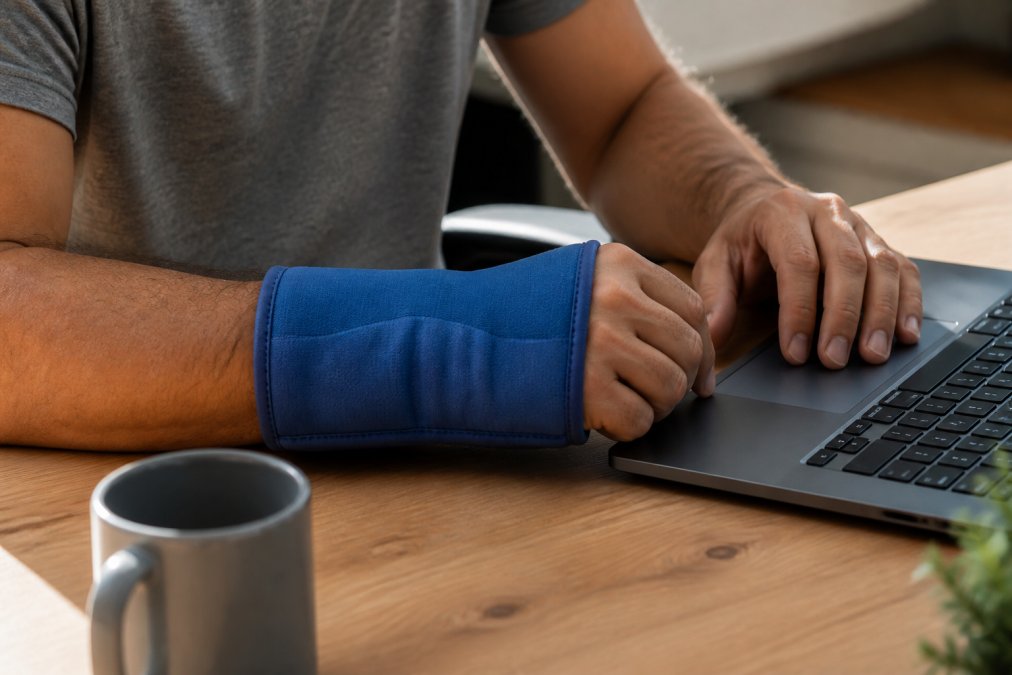
Here is how the 15-to-20-minute rule adapts, with the reasoning behind each number:
- Fingers and toes: 10-15 minutes. Minimal tissue mass and thin skin mean faster cooling and faster onset of numbness. Check skin every few minutes, and stop at the first sign of waxy or white skin. A finger sleeve should fit snugly enough to stay in contact but not so tight that it restricts blood flow on its own.
- Wrists: 15 minutes. The carpal tunnel sits just under the skin on the palm side, so cold reaches the median nerve quickly. This is useful for typing-related pain, but it also means you should not extend past 15 minutes on the palm side.
- Elbows and ankles: 15-20 minutes. These joints have more soft tissue and bony prominences (the olecranon, the malleoli) that need barrier protection. A wrap that stays put during movement matters more here than on a finger.
- Knees: 15-20 minutes. The largest joint in this group, with the thickest soft-tissue envelope, so it tolerates the full window. A fitted sleeve that maintains even contact is more effective than a loose gel pack that shifts.
- Back and large muscle groups (quads, hamstrings, calves): 15-20 minutes. Large mass means slower cooling, but also means a larger area of skin is exposed, so barrier coverage and even pressure matter more than duration.
Why fit changes the timing math
A common mistake is using one generic pack on every joint. A knee sleeve that fits well is useless on a finger, and a finger sleeve will not stay in contact on a knee. When a pack does not conform, you get uneven cooling: some spots over-cool while others barely cool, which pushes you toward either under-treating the injury or over-cooling a small patch of skin. Matching the sleeve to the joint keeps the cooling even across the treatment area, which is what lets you use the full recommended window safely. The National Institute of Arthritis and Musculoskeletal and Skin Diseases overview of joint conditions notes how joint structure varies widely, which is exactly why one-size timing and one-size fit both fall short.

Best Cold Compression for Sports Recovery and Post-Surgical Care
Cold compression for sports recovery and post-surgical care is a timing discipline, not a one-time fix. Athletes and post-op patients both benefit from the same 15-to-20-minute window, but the schedule around it differs.
For sports recovery, apply within 30 minutes of training or competition, then repeat every 2 to 3 hours for the first day. For post-surgical care, follow your surgeon's specific protocol; many call for cold compression every 2 hours while awake during the first 48 to 72 hours. Never exceed the 20-minute ceiling even when swelling looks stubborn.
This is where wearable sleeves earn their place. A hands-free sleeve lets you ice a knee while working, a wrist while typing, or a foot while resting, without holding anything in place. Penguin Fingers offers dual hot and cold options across its wearable cold compression sleeve range, covering knees, elbows, feet, wrists, and fingers.
- Sports recovery: within 30 min post-activity, then every 2-3 hours
- Post-surgical: every 2 hours while awake, per surgeon guidance
- Both: 15-20 minutes per session, 1-hour minimum gap
Safety Rules: Frostbite, Nerve Damage, and When to Stop
Frostbite and nerve damage are the real risks of over-icing, and they show up faster on thin-skinned areas like fingers and toes. The clinical picture to watch for is skin that turns white, waxy, or grayish, a burning sensation replacing the expected numbing, or numbness that lingers after you remove the pack. Any of those means stop and let the tissue rewarm gradually.
Barrier protection that actually works
"Don't apply ice directly to skin" is the advice every guide gives. What most skip is how thick the barrier should be. A single thin pillowcase or a damp paper towel is not enough for a full 20-minute session. A common practitioner standard is a dry cloth layer roughly the thickness of a folded hand towel, or about a quarter-inch of fabric, between the cold source and bare skin. Cotton and flannel work well because they hold a small amount of insulating air; synthetic athletic fabric compresses flat and offers less protection. If you are using a wearable sleeve designed for direct wear, the fabric itself is the barrier, but you should still check the skin every five minutes during your first few sessions, especially over bony prominences like the kneecap, the outer ankle, and the knuckles.
Why some people are at higher risk
The reason cold injury sneaks up on certain patients is that the early warning signal, pain and then numbness, is exactly the signal their condition blunts. That is the mechanism behind the contraindications below.
- Raynaud's phenomenon: Blood vessels over-constrict in response to cold. A normal 15-minute session can trigger a prolonged vasospasm, turning fingers white or blue and causing pain well after the pack is removed. Cold therapy is generally avoided on the hands and feet in these patients.
- Diabetes and peripheral neuropathy: Reduced sensation in the feet and hands means you may not feel the burning or numbing that would otherwise tell you to stop. Tissue damage can progress before any symptom appears. Get medical clearance and use shorter sessions with frequent skin checks.
- Peripheral vascular disease: Narrowed arteries already limit blood flow. Adding vasoconstriction can push tissue past its tolerance, so cold therapy is used cautiously if at all.
- Nerve damage or prior cold injury: Areas with known nerve damage have unreliable feedback. Treat them as high-risk and shorten sessions.
When to avoid cold therapy entirely
- Raynaud's phenomenon or poorly controlled poor circulation
- Open wounds, compromised skin, or active infection
- Areas with known nerve damage or prior frostbite
- Any joint that feels worse, not better, after application
- Over the spine, the front of the neck, or the abdomen without clinician guidance
Conclusion
Getting cold compression timing right comes down to one habit: 15 to 20 minutes on, at least an hour off, repeated consistently rather than aggressively. Most people fail not because they ice too little, but because they ice too long and too often, then wonder why swelling lingers.
Wearable cold compression sleeves built for specific joints, from fingers and toes to wrists, elbows, and knees, can make that discipline easy. Dual hot and cold options mean one product can cover both phases of recovery, and the hands-free fit can help keep you inside the therapeutic window without holding a melting pack in place.
Get started with Penguin Fingers and give your joints the steady, targeted cold compression they need to recover.
Frequently Asked Questions
How long can I leave a cold compress on?
Leave a cold compress on for 15 to 20 minutes at a time. This window is long enough to reduce swelling and numb pain without risking tissue damage. If you use a wearable cold compression sleeve, set a timer. Going longer than 20 minutes can cause frostbite or nerve damage, especially on fingers and toes where circulation is already limited. After removing the compress, wait at least 1 hour before applying it again.
How often can I use a cold compression sleeve?
You can use a cold compression sleeve every 1 to 2 hours during the first 48 hours after an injury. For chronic conditions like arthritis, 2 to 4 sessions per day is typical. The key is intermittent application: 15 to 20 minutes on, then at least 60 minutes off. This cycle lets your skin return to normal temperature and prevents cold-related damage. If you feel numbness or your skin turns white, stop and wait longer.
Does cold compression help reduce inflammation faster than ice alone?
Cold compression combines cooling with gentle pressure. The pressure helps limit fluid buildup in the tissue, which can reduce edema and swelling more effectively than ice alone. A 2023 study on post-operative knee patients found that cold compression sleeves reduced swelling by an additional 18% compared to standard ice packs. However, both methods work. The advantage of compression is consistent contact and hands-free use, which matters for fingers, wrists, and toes.
Can you use cold compression therapy for too long?
Yes. Using cold compression for more than 20 minutes at a time can cause frostbite, skin burns, or nerve damage. Signs you've gone too long include numbness that doesn't fade within a few minutes, skin that looks waxy or pale, and a sharp burning sensation. People with diabetes, poor circulation, or Raynaud's disease should limit sessions to 10 minutes and check their skin every few minutes. Always use a thin barrier between the pack and your skin.


