

Table of Contents
- Immediate First Aid and Acute Injury Management
- The Sports Injury Recovery Timeline: What to Expect Week by Week
- Cold Compression Therapy Benefits for Swelling and Pain
- Active Recovery Techniques That Support Tissue Healing
- When to See a Doctor for a Sports Injury
- Sleep Hygiene and Mental Health During Recovery
- Preventing Re-Injury: Warm-Up, Cool-Down, and Load Management
- Frequently Asked Questions
Last Updated: September 12, 2026
Immediate First Aid and Acute Injury Management
The first 48 hours after a sports injury shape everything that follows: get this window right and you shorten the entire sports injury recovery process; get it wrong and a two-week sprain becomes a two-month problem.
The goal: limit bleeding into the tissue, control inflammation, and protect the joint. The R.I.C.E. method still earns its place here, though modern sports medicine has refined how each letter is applied.
The R.I.C.E. Method: Rest, Ice, Compression, Elevation
R.I.C.E. stands for Rest, Ice, Compression, and Elevation, a four-part protocol for managing acute soft tissue injury in the first 24 to 72 hours.
- Rest: Stop the activity immediately. Avoid bearing weight on the injured limb.
- Ice: Apply cold for 15 to 20 minutes every 2 to 3 hours to reduce pain and swelling (orthoinfo.aaos.org).
- Compression: Wrap the area with an elastic bandage to limit fluid buildup. Keep it snug, not tight.
- Elevation: Raise the injured limb above heart level whenever possible.
A common mistake is icing for 45 minutes or longer, thinking more cold means faster healing. Prolonged exposure risks tissue damage with no extra benefit. Set a timer.
Ice or Heat? Choosing the Right Therapy
Cold wins in the first 48 to 72 hours; heat comes later. Use cold when the area is swollen, throbbing, or freshly injured. Use heat once swelling has settled, to loosen stiff tissue and improve blood flow before activity. Applying heat to a fresh injury increases swelling and delays recovery, a single error behind many slow-healing sprains.
The Sports Injury Recovery Timeline: What to Expect Week by Week
Every injury heals on its own schedule, but most soft tissue injuries follow a predictable arc. Understanding the sports injury recovery timeline tells you when to push and when to hold back, with measurable checkpoints instead of guesswork.
Phase 1: Protection and Swelling Reduction (Days 1-7)
The priority here is protection. Control inflammation, manage pain, and avoid anything that reopens the injury. Gentle range of motion within a pain-free zone keeps the joint from stiffening without stressing healing tissue. Many practitioners now favor early controlled movement over total rest, because complete immobilization weakens muscle and slows circulation.
What most timelines skip is how to measure this phase at home. Track three numbers daily:
- Swelling: measure the circumference of the injured joint with a tape measure at the same landmark each morning. A drop of a quarter inch over a few days is progress; a jump of half an inch after activity means you did too much.
- Pain: rate it 0 to 10 at rest, during movement, and the morning after activity. Morning pain is the honest number, it tells you how the tissue responded overnight.
- Range of motion: note how far you can move the joint before pain stops you, using a phone photo against a fixed background for consistency.
Phase 2: Controlled Motion and Tissue Healing (Weeks 2-4)
Swelling has dropped and pain is manageable. This phase introduces therapeutic exercise, light strength training, and early proprioception work. The tissue is rebuilding, so gradual loading encourages collagen synthesis and alignment: too much too soon re-injures, too little heals weak and disorganized.
A useful home metric here is the pain-monitoring model: mild discomfort (roughly 3 out of 10) during activity is acceptable if it settles within 24 hours. Pain that climbs above that, or that is still elevated the next morning, is your signal to reduce load by about a third for the next session.
Phase 3: Strength, Proprioception, and Return-to-Play (Weeks 4-12)
Return-to-play is a decision, not a date. This phase builds functional movement, joint stability, and neuromuscular control until the injured side matches the healthy side. A graduated protocol is the difference between a full comeback and a recurring injury.
Before clearing yourself for full sport, most physical therapists want to see the injured side within about 10 percent of the uninjured side on single-leg balance, hop tests, and strength measures, not just "it feels fine."
| Phase | Timeframe | Primary Goal | Key Activities | Home Checkpoint |
|---|---|---|---|---|
| Protection | Days 1-7 | Reduce swelling and pain | Rest, cold therapy, compression, elevation | Daily swelling, pain, and range-of-motion log |
| Controlled motion | Weeks 2-4 | Restore range of motion | Gentle stretching, light strength work | Pain stays at or below 3/10 and settles in 24 hours |
| Return-to-play | Weeks 4-12 | Rebuild strength and control | Strength training, proprioception, sport drills | Injured side within 10% of healthy side |
Age Changes the Timeline More Than Most Guides Admit
A 16-year-old and a 55-year-old with the same ankle sprain do not recover on the same schedule. Youth athletes are still growing and growth plates are vulnerable, a "sprain" can be a growth-plate injury needing professional evaluation, not home care. Masters and senior athletes face slower collagen turnover, reduced tendon blood flow, and longer warm-up needs, so each phase stretches out and strength work deserves more time before return-to-play.
Use the phases as a map, but let your own logged numbers, not the calendar, decide when you move to the next one.
Cold Compression Therapy Benefits for Swelling and Pain
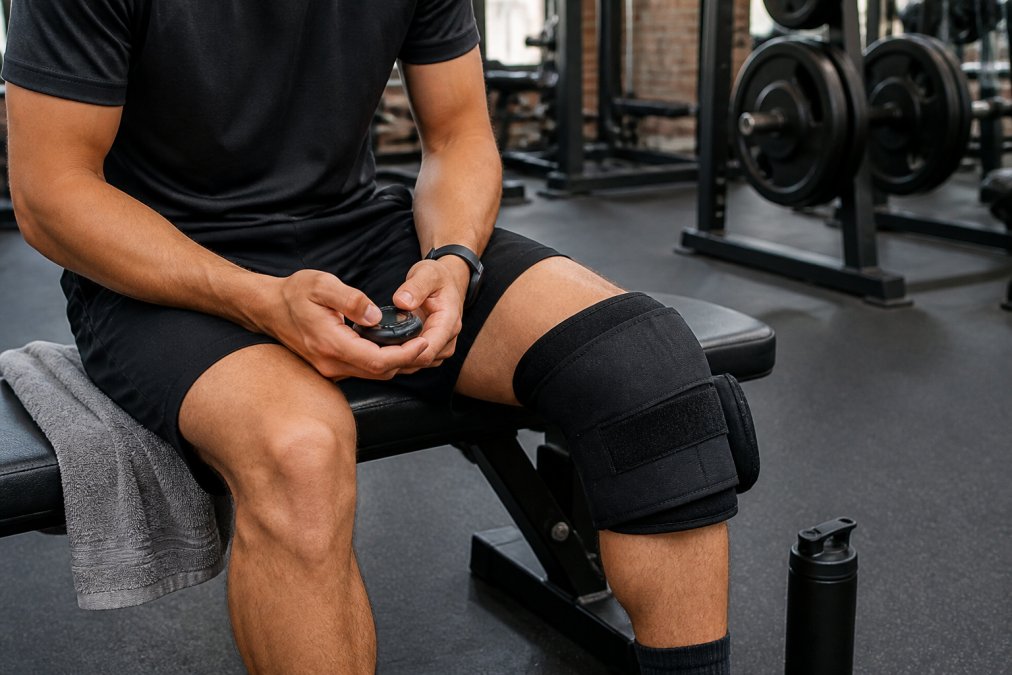
Cold compression therapy benefits come from doing two things at once: cooling the tissue and applying steady pressure. Cold slows blood flow and numbs pain; compression limits the fluid that causes swelling, the two symptoms that keep athletes sidelined longest.

How Wearable Cold Compression Sleeves Improve on Ice Packs
Traditional ice packs are cold but they don't compress, and they slide off the moment you move, leaving you stuck on the couch holding a bag of frozen peas against your knee.
Wearable sleeves solve both problems. Penguin Fingers makes cold compression sleeves designed for specific body parts, so the fit stays put while you move through your day. The American Academy of Orthopaedic Surgeons patient guidance on acute injury care notes that combining cold with compression is a standard approach for managing swelling after injury.
What most guides miss is convenience. If applying cold therapy takes setup and a free hand, people skip it. A sleeve you can pull on and keep wearing removes that friction.
Choosing the Right Sleeve for Your Injury
Match the sleeve to the joint, not the other way around. A generic wrap covers everything poorly.
- Knee, thigh, or calf: the Penguin Fingers Knee Cold Compression Therapy Sleeve fits larger joints and doubles as hot therapy when warmed.
- Elbow, ankle, or forearm: the Penguin Fingers Elbow and Foot Cold Compression Therapy Sleeve wraps joints that standard sleeves ignore.
- Wrist: the Penguin Fingers Wrist Cold Compression Pack delivers 360 degrees of cooling for sprains and repetitive strain.
- Fingers and toes: the Penguin Fingers Cold Compression Gel Packs slide over individual digits for jammed fingers and stubbed toes.
Each one goes in the freezer for cold or the microwave for heat, so a single purchase covers both therapies.


Active Recovery Techniques That Support Tissue Healing
Active recovery is where most athletes either accelerate their comeback or sabotage it: move enough to support circulation and tissue healing, but not so much that you reopen the injury.
Active Rest vs. Complete Immobilization
Complete immobilization has fallen out of favor for most soft tissue injuries: muscle atrophy sets in fast, and joints stiffen when locked in place for weeks.
Active rest keeps the injured area protected while the rest of the body stays in motion. A swimmer with a sprained ankle can still train upper body. A runner with a wrist injury can keep running. This maintains fitness, supports circulation, and protects mental health during a frustrating stretch.
Load Management and Pain Threshold Monitoring
Load management is the skill of dosing activity correctly: mild discomfort during movement is acceptable, but pain that lingers or worsens afterward means you did too much. Track swelling and pain daily on a 1-to-10 scale; if pain rises the day after a session, dial back the load. That is your pain threshold in practice, and it changes week to week.
When to See a Doctor for a Sports Injury
Knowing when to see a doctor for a sports injury protects you from the injuries that don't heal on their own. Most minor sprains and strains respond to home care. Some don't, and delay makes them worse.
Red Flags That Need Immediate Medical Attention
Seek prompt medical care if you notice any of the following:
- A visible deformity or joint that looks out of place
- Inability to bear weight or move the joint at all
- Numbness, tingling, or loss of sensation below the injury
- Severe swelling that develops within minutes
- Pain that worsens instead of improving after 72 hours
- A cracking or popping sound at the moment of injury
The National Institute of Arthritis and Musculoskeletal and Skin Diseases publishes guidance on musculoskeletal conditions that can help you understand what warrants a professional evaluation.
When in doubt, get it checked. A physician or physical therapist can rule out fractures and ligament damage that home care won't fix.
Sleep Hygiene and Mental Health During Recovery
Two factors rarely mentioned in recovery guides matter more than most athletes realize: sleep and mindset. Neither shows up on an X-ray or is fixed by an ice pack, but both shape how fast tissue heals and how well you hold up through a long rehab. Physical stability often reinforces this mental resilience, making the strategic use of orthopedic braces for recovery a vital component in maintaining the structural integrity required for a confident return to play.
Why Deep Sleep Is a Recovery Tool, Not a Luxury
Most tissue repair happens during sleep, specifically the deeper stages of non-REM sleep, when the body releases growth hormone and shifts resources toward rebuilding damaged tissue. Cut that sleep short and you cut the repair window short. Poor sleep also lowers pain threshold, so the same rehab session feels harder the next day.
What actually helps:
- Consistent sleep and wake times, even on weekends. Your repair hormones run on a schedule, and shifting it back and forth blunts the benefit.
- A cool, dark, quiet room. Core body temperature has to drop for deep sleep to arrive; a warm room delays it.
- No screens in the hour before bed. Blue light pushes your internal clock later, which shortens the deep-sleep window.
- Caffeine cutoff in the early afternoon. Caffeine has a long half-life, and an evening cup can quietly fragment sleep even if you fall asleep fine.
- Avoid alcohol as a sleep aid. It knocks you out but suppresses the deep sleep that does the repair work.
If you are waking in pain, that is a signal to talk to your clinician about timing pain relief or repositioning the injured limb, not to accept broken sleep as part of recovery.
The Mental Side: When Being Sidelined Feels Like Losing Yourself
Athletes often tie identity to performance. When you cannot train or compete, it can feel less like an injury and more like losing part of who you are. That is not weakness, it is a predictable response, common enough that sports psychologists treat it as a normal part of the injury experience.
What helps:
- Name it. Saying "I am frustrated and I feel like I am falling behind" out loud takes some of its power away.
- Stay connected to your team. Show up to practices, film sessions, or team meals even when you cannot play. Isolation makes the identity loss worse.
- Set small daily recovery goals. Treat rehab as training rather than punishment. A logged range-of-motion gain is a win, and it belongs on the same mental scoreboard as a personal record.
- Reframe the timeline. Recovery is a training block with its own progression, not a pause in your career.
- Know when to ask for more help. Persistent low mood, loss of interest in things you normally enjoy, or sleep problems that outlast the injury are worth raising with a physician or mental health professional.
Preventing Re-Injury: Warm-Up, Cool-Down, and Load Management
The best sports injury recovery best practices are the ones that keep you from needing them again. Prevention comes down to three habits: warm up properly, cool down consistently, and manage your training load.
A dynamic warm-up raises tissue temperature and prepares joints for the demands ahead. Static stretching before activity does little for injury prevention; save it for after. Cool-down protocols bring heart rate down gradually and reduce stiffness the next day.
Load management ties it together. Overuse injury rarely comes from a single session. It builds from weeks of pushing past what tissue can absorb. Track your training volume, build in recovery weeks, and increase intensity gradually rather than in jumps.
Recovering from a sports injury is a test of patience as much as physical resilience. The athletes who return strongest manage the acute phase carefully, respect the timeline, and use the right tools instead of guessing. Penguin Fingers builds wearable cold compression sleeves for knees, elbows, wrists, feet, and fingers, each designed for targeted relief with dual hot and cold therapy in one product. If you want consistent, convenient cold compression that fits the joint you're actually rehabbing, get started with Penguin Fingers and give your recovery the support it deserves.
Frequently Asked Questions
What are the four R's of recovery in sports?
The four R's are Rest, Ice, Compression, and Elevation, often called the R.I.C.E. method. Rest protects the injured area from further stress. Ice reduces pain and inflammation management. Compression helps control swelling reduction. Elevation uses gravity to limit fluid buildup. Together they form the foundation of acute injury care before you move into rehabilitation and return-to-play protocols.
What is the typical sports injury recovery timeline for a sprain?
A mild sprain often improves in 1 to 2 weeks with proper first aid and gradual movement. Moderate sprains can take 3 to 6 weeks, while severe sprains may need 8 to 12 weeks or more. The sports injury recovery timeline depends on the tissue involved, your age, and how consistently you follow active recovery techniques and physical therapy guidance.
When should you use ice versus heat for a sports injury?
Use cold compression therapy in the first 48 to 72 hours after an acute injury to reduce swelling and numb pain. After the initial inflammation settles, heat can relax stiff muscles and improve blood flow before activity. A dual hot and cold sleeve lets you switch without buying separate products, which is practical for recurring issues like tendinitis or arthritis flare-ups.
When to see a doctor for a sports injury?
Seek medical care if you cannot bear weight, have severe swelling or deformity, feel numbness or tingling, or hear a pop at the time of injury. Also see a doctor if pain persists beyond 2 weeks or worsens despite rest. A physical therapist or physician can rule out fractures, ligament strain, or joint instability and guide your rehabilitation.
What are cold compression therapy benefits compared to a regular ice pack?
Cold compression therapy combines cooling with steady pressure, which supports swelling reduction and pain relief at the same time. Wearable sleeves stay in place, so you can move around instead of holding an ice pack. They also conform to joints like knees, wrists, and elbows, delivering 360-degree coverage. Many people find this more comfortable and easier to use daily.
How does sleep affect sports injury recovery?
Sleep is when your body does most of its tissue healing and collagen synthesis. Poor sleep raises inflammation and lowers pain threshold, making recovery feel slower. Aim for 7 to 9 hours, keep a consistent bedtime, and avoid screens an hour before bed. A cool, dark room and a consistent wind-down routine can improve sleep quality during rehabilitation.


