

Table of Contents
- Immediate Steps After an Ankle Sprain: The First 72 Hours
- Ankle Sprain Recovery Timeline for Runners: What to Expect Week by Week
- Cold Compression Therapy for Sports Injuries: Why It Works and How to Use It
- Exercises for Ankle Stability After Sprain: A Progressive Program
- Cross-Training and Nutrition: The Recovery Accelerators Most Runners Ignore
- Avoiding Re-Injury: Footwear Adjustments and Psychological Readiness
- When to See a Doctor or Physical Therapist
- Conclusion: Your Action Plan for a Faster Ankle Sprain Recovery
- Frequently Asked Questions
Last Updated: September 10, 2026
Immediate Steps After an Ankle Sprain: The First 72 Hours
The 72 hours after an ankle sprain decide how fast you get back to running. A ligamentous injury triggers inflammation, edema, and pain that, managed poorly, can stretch a two-week setback into two months. This guide from Penguin Fingers walks through how to speed up ankle sprain recovery for runners, from the acute phase through your first pain-free miles.
The old RICE formula (rest, ice, compression, elevation) has largely given way to POLICE: protection, optimal loading, ice, compression, and elevation. The shift matters. Complete rest weakens the surrounding tissue, while controlled loading stimulates repair.
Here is the sequence that works:
- Stop running immediately and protect the joint from further inversion stress.
- Apply cold compression within the first hour.
- Elevate the ankle above heart level for 15-20 minutes at a time.
- Begin gentle, pain-free range of motion as soon as tolerated.
- Avoid heat, alcohol, and deep massage for the first 48 hours.
A common mistake is testing the ankle too early. If walking hurts, running will set you back further.
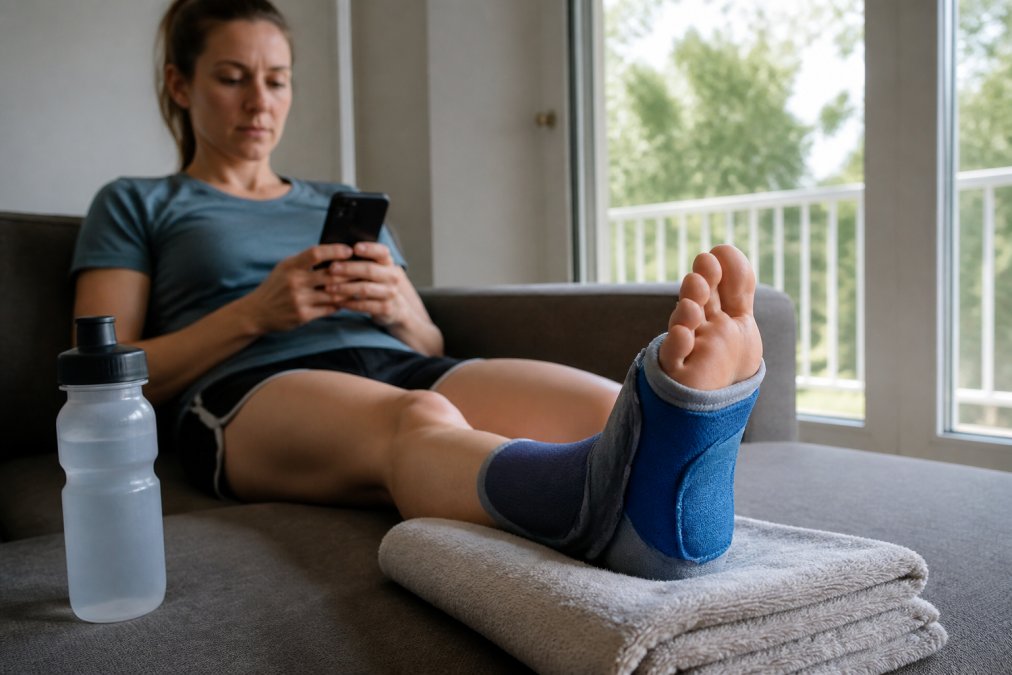
How to Apply Cold Compression Correctly
Cold compression combines cryotherapy with external pressure, and the pairing outperforms either alone for swelling. The cold narrows blood vessels to limit edema; the compression stops fluid from pooling around the joint.
Apply a wearable cold compression sleeve for 15-20 minutes, then remove it for at least 45 minutes before repeating (orthoinfo.aaos.org). Never leave ice directly on skin, and never sleep in a cold wrap. Most runners repeat this three to five times daily during the acute phase.

Ankle Sprain Recovery Timeline for Runners: What to Expect Week by Week
Most grade I and grade II sprains follow a predictable arc: swelling and pain control in weeks one and two, strength and stability work through weeks three to six, and a graded return to running from week seven (peer-reviewed research). Grade III injuries, where the ligament is fully torn, take longer and need a physician's input before any loading begins.
The timeline below is a guide, not a contract. Your tissue heals on its own schedule, and pushing the phases is how runners end up back at week one. What separates a fast recovery from a stalled one is not the calendar, it is whether you meet objective criteria before advancing. Use the milestones in the right-hand column, not the week number, to decide when to move forward.
| Phase | Typical Weeks | Focus | Advance When You Can... | Running Status |
|---|---|---|---|---|
| Acute | 1-2 | Pain and edema control | Bear weight and walk without a limp | No running |
| Rehab | 3-6 | Strength and proprioception | Single-leg balance 30 seconds, eyes closed, no wobble | Pool or bike only |
| Return | 7+ | Gradual loading | Hop on the injured leg 10 times without pain | Walk-run progression |
Weeks 1-2: Pain and Swelling Control
Protect the joint and let inflammation settle. Keep weight-bearing to a pain-free threshold, use cold compression several times daily, and elevate whenever you sit. Gentle ankle pumps and circles keep range of motion from stiffening.
The milestone that ends this phase is simple: you can walk across a room without a limp. Until you can, running is off the table. A common pattern is that swelling drops noticeably by day three to five, but the joint still feels unstable for another week, that instability, not the swelling, is what tells you the ligament is not ready.
Weeks 3-6: Building Strength and Stability
This is where functional rehabilitation begins. Add resistance work, balance training, and controlled calf raises. The goal is to rebuild the stabilization the ligament can no longer provide on its own.
Concrete targets for this phase:
- Single-leg balance for 30 seconds with eyes open, then progress to eyes closed.
- 15 single-leg calf raises with full range, no pain.
- Heel walks and toe walks for 20 yards each.
- Light resistance-band work in all four directions: dorsiflexion, plantar flexion, inversion, eversion.
If any of these produce sharp pain or visible swelling the next morning, you advanced too fast. Drop back a step and rebuild.
Weeks 7+: Return to Running
Start with a walk-run pattern on flat, even ground. A workable structure is a five-minute walk to warm up, then alternate one minute of easy jogging with two minutes of walking for 20 minutes total, three times in the first week. If you finish with no pain and no swelling the next morning, progress to two minutes of jogging with one minute of walking. Build jogging intervals before you build total distance.
Increase training volume slowly, most practitioners suggest no more than a 10 percent weekly increase in total running time, and back off at the first sign of swelling. A return-to-run plan that respects the pain-free threshold beats one that follows a calendar.
The Fear-of-Re-Injury Factor
Most timelines ignore the mental side, and that is a mistake. Runners who do not trust the ankle unconsciously shorten their stride and land more flat-footed, which changes loading patterns and can itself cause problems. Rebuild confidence with graded exposure: short, controlled efforts that end before pain, repeated until trust returns. Treat the first few weeks of running as a confidence-building exercise, not a fitness test.
Cold Compression Therapy for Sports Injuries: Why It Works and How to Use It
Cold compression therapy for sports injuries works by combining two mechanisms: cryotherapy reduces tissue temperature to limit inflammation and pain signaling, while compression therapy manages edema and supports venous return. Together they address the swelling that restricts range of motion.
The practical rules:
- Use cold for the first 72 hours and after any rehab session that flares the ankle.
- Switch to heat only once acute swelling has resolved, typically after the first week.
- Keep sessions to 15-20 minutes to avoid tissue damage.
- Use a sleeve sized to the ankle, not a generic wrap that slides.
The American Academy of Orthopaedic Surgeons guidance on sprained ankles outlines the same progression from protection to progressive loading.
Exercises for Ankle Stability After Sprain: A Progressive Program
Exercises for ankle stability after sprain should move through three phases: range of motion, then balance and proprioception, then sport-specific loading. Proprioception, your joint's sense of position, is what an inversion sprain damages most, and it is what most runners neglect. osteopathy for injuries.
Phase 1: Range of Motion and Gentle Strengthening
Begin with ankle alphabet tracing, towel scrunches, and seated dorsiflexion and plantar flexion against light resistance. These restore movement without stressing the healing ligament.
Phase 2: Balance and Proprioception Training
Stand on the injured leg, progressing from eyes open to eyes closed, then from a firm floor to a foam pad. Add single-leg calf raises and heel walks. Balance training rebuilds the reflexive stabilization that prevents re-injury.
Phase 3: Sport-Specific Drills
Introduce lateral hops, bounding, and cutting drills on soft surfaces before returning to the road. These mimic the biomechanics of running and expose any remaining weakness.
Cross-Training and Nutrition: The Recovery Accelerators Most Runners Ignore
Maintaining fitness while the ankle heals keeps you sane and preserves your aerobic base. The key is choosing modalities that load the cardiovascular system without the impact or lateral stress that aggravates a sprain. Not all cross-training is equal, some options stress the ankle more than runners expect.
Cross-Training That Actually Spares the Ankle
- Deep-water running. The closest substitute for real running. Use a flotation belt in the deep end and mimic your normal stride for 30-45 minutes. Heart rate runs slightly lower than land running at the same perceived effort, so expect to work a little harder to hit your usual zones.
- Swimming. Freestyle and backstroke are fine; avoid whip kicks if they cause ankle discomfort. 30-40 minutes, three times a week, maintains aerobic fitness.
- Stationary cycling. Set the seat high enough that the ankle stays in a comfortable range, and start with low resistance. A stable foot position matters more than cadence early on.
- Elliptical. Low-impact and weight-bearing, but the foot is fixed to the pedal, so it can irritate a stiff ankle. Skip it in the first two weeks.
- Rowing. Good cardiovascular work, but the catch position demands ankle dorsiflexion. Only add it once you have full range of motion.
A practical weekly structure: two or three cross-training sessions of 30-45 minutes on non-rehab days, plus your daily rehab work. Keep the intensity easy to moderate, this is about maintaining fitness, not building it.
Nutrition for Ligament Repair
Connective tissue rebuilds from protein and specific micronutrients, and most runners under-eat both during recovery. Ligaments are largely collagen, and collagen synthesis depends on vitamin C and amino acids.
- Protein. Aim for a palm-sized portion of lean protein at every meal. Connective tissue repair is an ongoing process, not a post-workout event.
- Vitamin C. Citrus, bell peppers, and leafy greens support collagen formation. A common pattern is that runners get plenty of protein but skimp on vitamin C.
- Collagen-supporting foods. Bone broth, eggs, and dairy provide the amino acids collagen is built from. Some practitioners suggest pairing collagen intake with vitamin C, though the evidence is still developing.
- Anti-inflammatory foods. Fatty fish, olive oil, and colorful vegetables support the body's own inflammation-resolution process.
- What to limit. Alcohol and heavily processed foods work against tissue healing and can worsen swelling. Cutting alcohol for the first two weeks is one of the simplest levers you have.
Avoiding Re-Injury: Footwear Adjustments and Psychological Readiness
Re-injury prevention starts with footwear adjustments. A shoe with a wider base and a more stable heel counter reduces the inversion moment that caused the sprain in the first place. If you overpronate, a stability shoe may help; if you run trails, tread and midsole firmness matter even more.
The psychological side is real. Fear of re-injury keeps many runners from committing to a full stride, which changes gait mechanics and can itself cause problems. Rebuild confidence with graded exposure: short, controlled efforts that end before pain, repeated until trust returns.
When to See a Doctor or Physical Therapist
See a doctor if you cannot bear weight for four steps, if the swelling is severe, or if pain sits directly over the bone rather than the ligament. These signs can indicate a fracture or a high ankle sprain that needs imaging.
A physical therapist helps with cases that stall. If swelling persists past two weeks, if range of motion does not return, or if you are an athlete needing a structured return plan, professional guidance shortens the path. Podiatry input is worth considering if your gait or foot structure contributed to the injury.
Conclusion: Your Action Plan for a Faster Ankle Sprain Recovery
Recovering from an ankle sprain is less about heroics and more about consistency: manage the acute phase, load the joint progressively, and respect the pain-free threshold at every stage. The runners who return strongest are the ones who treat rehab as training.
Penguin Fingers makes the cold compression portion simpler with wearable sleeves designed for specific joints. The Elbow and Foot Cold Compression Therapy Sleeve wraps the ankle for targeted hot or cold therapy, and the dual hot and cold design means one sleeve covers both the acute phase and the stiffness that follows. Get started with Penguin Fingers and give your ankle the consistent, wearable cold compression that supports a faster return to running.
Frequently Asked Questions
How long after a sprained ankle can you jog?
Most runners can begin a walk-jog progression around week 3 to 4, provided they have full range of motion, minimal swelling, and can walk without a limp. Start with 1 minute of jogging followed by 2 minutes of walking, repeated 8 to 10 times. Increase jogging time by 1 minute every 2 to 3 days if you remain pain-free. If pain returns, drop back to the previous level. A physical therapist can help you set a safe timeline based on your specific injury grade.
What are the best cold compression techniques for ankle injuries?
Apply cold compression for 15 to 20 minutes every 2 to 3 hours during the first 48 to 72 hours after injury. Use a wearable cold compression sleeve that wraps around the ankle to combine cooling and pressure, which helps reduce edema and numb pain. Elevate the ankle above heart level while applying cold. Avoid placing ice directly on the skin; always use a barrier like a thin towel. After the acute phase, switch to cold compression after rehab exercises to manage any flare-ups.
What exercises help stabilize the ankle after a sprain?
Start with range-of-motion drills like ankle circles and towel scrunches. Then progress to calf raises, single-leg balance holds, and resistance band work for dorsiflexion and plantar flexion. Balance training on a foam pad or wobble board improves proprioception and reduces re-injury risk. Add lateral hops and figure-eight runs as you advance. Perform these exercises for at least 6 to 8 weeks, even after pain subsides, to rebuild ligament strength and prevent future sprains.
When is it safe to return to high-impact running after a sprain?
You can return to high-impact running when you have full pain-free range of motion, no swelling, and can hop on the injured ankle 10 times without pain or instability. This typically takes 4 to 8 weeks for a moderate sprain. Progress gradually: start with easy jogging on flat surfaces, then add speed work and hills only after 2 weeks of pain-free jogging. If you feel any giving way or sharp pain, stop and consult a physical therapist.


