

Table of Contents
- Understanding Finger Arthritis: Causes and Symptoms
- Finger Arthritis Exercises for Mobility and Flexibility
- How to Reduce Hand Inflammation with Cold Compression Therapy
- Cold Compression Therapy for Joints: What to Expect
- Over-the-Counter Pain Relief and Topical Treatments
- Assistive Tools and Ergonomic Changes for Daily Tasks
- Managing the Emotional Toll of Chronic Finger Pain
- When to See a Doctor and What to Ask
- Frequently Asked Questions
Last Updated: October 2, 2026
Understanding Finger Arthritis: Causes and Symptoms
Finger arthritis is the breakdown of cartilage in the joints of your hands, which leads to pain, stiffness, and swelling. This guide from Penguin Fingers walks through how to manage finger arthritis at home, from morning stretches to cold compression therapy and simple changes around the house.

Two main types cause most finger pain. Osteoarthritis comes from years of wear on the joints. Rheumatoid arthritis is an autoimmune condition where the body attacks its own joint lining. Both make everyday tasks harder, but they behave differently.
Osteoarthritis vs. Rheumatoid Arthritis in the Fingers
Osteoarthritis is the wear-and-tear form. It usually shows up in the joint closest to the fingertip or at the base of the thumb. The cartilage that cushions the joint breaks down over time.
Rheumatoid arthritis is different. It's an inflammatory disease that often hits the same joints on both hands at once. The Arthritis Foundation overview of rheumatoid arthritis notes that early treatment matters most for this type.
Here's the quick difference:
| Feature | Osteoarthritis | Rheumatoid Arthritis |
|---|---|---|
| Cause | Cartilage wear | Autoimmune attack |
| Joints affected | Often one side | Usually both hands |
| Stiffness timing | Worsens with use | Worst in the morning |
| Swelling | Bony bumps | Soft, warm swelling |
Warning Signs You Should Not Ignore
Some symptoms need a doctor's visit, not a home remedy.
- Joints that stay red and warm for days
- Stiffness lasting more than an hour after waking
- Fingers that lock or click when you bend them
- Pain that wakes you at night
- Visible swelling that keeps growing
Finger Arthritis Exercises for Mobility and Flexibility
Finger arthritis exercises keep joints moving and slow stiffness. The goal is gentle motion, not a workout. Move slowly, and stop if pain sharpens.
A common mistake is skipping exercise on bad days. That's exactly when gentle movement helps most. Try each move for a slow count of five.
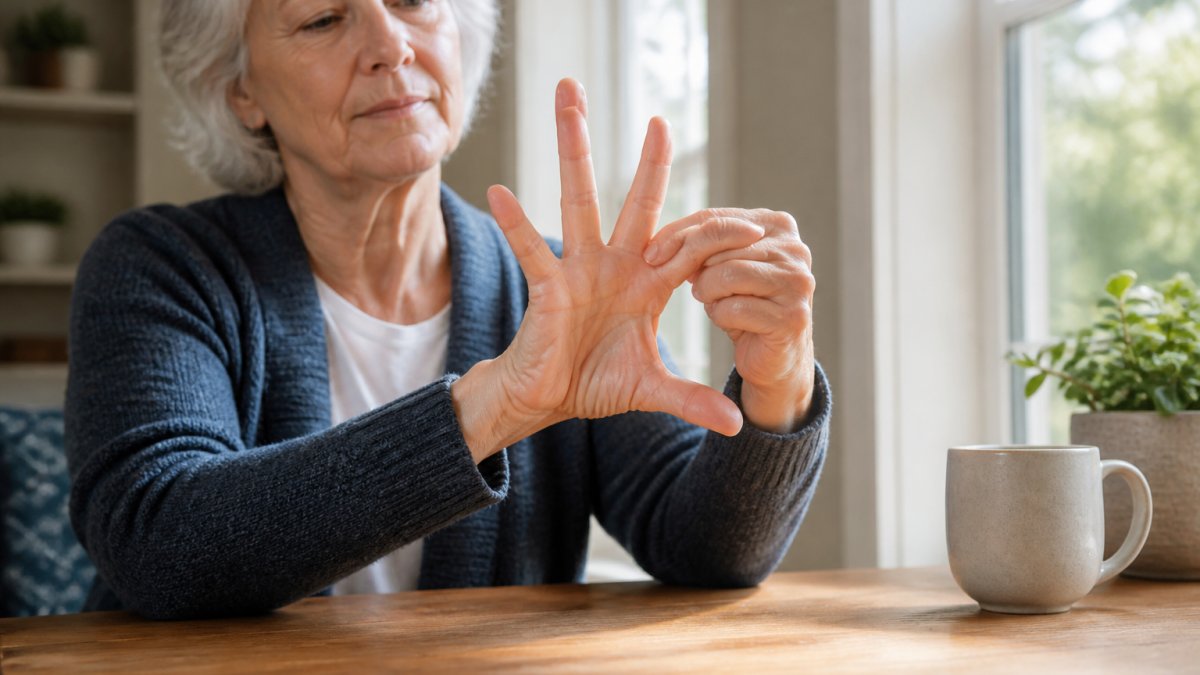
Step-by-Step Morning Routine for Stiff Fingers
This routine takes about five minutes. Do it before you grip anything.
- Warm up: Soak hands in warm water for two minutes.
- Finger curls: Bend each finger to your palm, one at a time.
- Thumb touches: Touch your thumb to each fingertip in turn.
- Fist stretch: Make a soft fist, then spread fingers wide.
- Wrist turns: Rotate wrists slowly, five times each way.
How to Reduce Hand Inflammation with Cold Compression Therapy
To reduce hand inflammation, apply cold compression to the sore joints. Cold narrows blood vessels, which calms swelling and numbs pain. Compression adds gentle pressure that pushes fluid away from the joint.
This is where cold compression therapy for joints earns its place. A wearable sleeve stays on your hand while you keep moving. Penguin Fingers makes a finger and toe cold pack that slips over each digit, so you cool only the joint that hurts. Our revolutionary patent-pending mega soft, super stretchy material provides an even comfortable cool compression for fingers of all sizes.
Heat vs. Cold: When to Use Each
Heat and cold do different jobs. Pick based on what your hand feels like right now.
- Use cold for fresh swelling, flare-ups, or after activity
- Use heat for stiff, tight joints with no swelling
- Use cold right after an injury
- Use heat before exercise to loosen up
| Symptom | Best Choice | Why |
|---|---|---|
| Swollen, hot joint | Cold | Reduces swelling |
| Stiff, achy morning hands | Heat | Loosens tissue |
| After activity | Cold | Calms flare-ups |
| Before exercise | Heat | Improves range of motion |
Cold Compression Therapy for Joints: What to Expect
Cold compression therapy for joints works best in short, repeated sessions. Most people apply cold for 10 to 15 minutes at a time. Wait at least an hour before repeating.
You should feel relief within the first few sessions. Swelling often drops over a few days of steady use. The Cleveland Clinic guide to cold therapy explains that cold slows blood flow to ease pain and swelling.
A wearable sleeve beats a loose ice bag. It stays put, so you can type, read, or cook while it works. Penguin Fingers designed its sleeves with a soft, stretchy material that fits fingers of all sizes. Our Penguin Fingers Cold Compression Gel Packs for Fingers and Toes are one size fits all, non-toxic, and latex-free.
Over-the-Counter Pain Relief and Topical Treatments
Over-the-counter options can ease pain between therapy sessions. They don't fix the joint, but they make the day easier.
- NSAIDs: Ibuprofen and naproxen reduce pain and swelling
- Acetaminophen: Eases pain without fighting inflammation
- Topical analgesics: Creams with lidocaine numb the surface
- Topical anti-inflammatories: Gels with diclofenac target the joint
- Supplements: Glucosamine, chondroitin, and MSM are popular, though results vary
Talk to your doctor before mixing pain relievers. Some interact with blood pressure or heart medicines. The FDA guidance on safe NSAID use warns that long-term use carries risks.
Assistive Tools and Ergonomic Changes for Daily Tasks
Most guides stop at "use a jar opener." That advice is useless if you don't know which opener, why it works, or what it costs. This section names the tools, explains the mechanism, and maps them to the tasks that hurt most.
Penguin Fingers Cold Compression Gel Packs for Fingers and Toes →
The principle behind every adaptive tool is the same: replace a pinch, twist, or tight grip with a lever, a larger surface, or a whole-hand motion.
Kitchen Tools That Actually Reduce Joint Load
- Jar openers with a lever arm: Under-cabinet models (like the popular wall-mounted style sold at most hardware stores) let you clamp the lid and turn the jar with one hand. The lever multiplies your grip force, so you need far less pinch strength. Expect to pay $10-$25.
- Electric can openers: A manual can opener forces a sustained wrist twist and a tight squeeze. A $15-$30 electric model removes both motions entirely.
- Built-up utensil handles: Foam tubing (sold in rolls for a few dollars) slides over forks, knives, and pens. A larger diameter means your fingers curl less tightly to hold the tool.
- Rocker knives: The curved blade lets you rock through food with a whole-hand press instead of a sawing grip. A basic model runs $15-$40.
- Pull-tab and ring-pull helpers: Small hook tools (often under $10) let you open cans and pull tabs with a lever motion rather than a fingertip pinch.
- Lightweight, wide-handled pans: Cast iron is the enemy here. A 2-3 lb nonstick skillet with a thick handle is far easier to lift and control.
Office and Around-the-House Adjustments
- Pen and pencil grips: A molded grip (a few dollars for a pack) widens the barrel so you don't have to pinch hard to write.
- Vertical mice and trackballs: These keep your wrist in a neutral position and shift clicking from your fingers to your thumb or palm. Prices range from about $20 to $100.
- Keyboard wrist rests and negative-tilt legs: Raising the back of the keyboard (negative tilt) keeps wrists straight. Take a 20-second break every 20 minutes, the "20-20-20" rule from eye-strain guidance works for hands too.
- Key turners and door-handle levers: A key turner gives you a full-hand grip to turn a stubborn lock. Lever-style door handles (or inexpensive lever adapters) replace the twist-and-pinch of a round knob.
- Zipper pulls and button hooks: A button hook (often under $10) threads through a buttonhole so you pull instead of pinch. Zipper pull extensions do the same for zippers.
- Electric toothbrushes with thick handles: The vibration does the work, so you don't scrub with a tight grip.
How to Choose Without Overspending
You don't need to buy everything at once. Start with the two or three tasks that hurt most, buy the cheapest tool that solves each one, and test it for a week. A $5 foam grip that works beats a $60 gadget that sits in a drawer.
For repetitive strain from typing or crafting, a wearable cold pack from Penguin Fingers can cool hot joints after a long session. Our Penguin Fingers Cold Compression Gel Packs for Fingers and Toes are available for $14.95.
Managing the Emotional Toll of Chronic Finger Pain
Chronic pain doesn't stay in your hands. It follows you into your mood, your sleep, and your relationships. That's not weakness, it's biology. Pain signals run through the same nervous system pathways that regulate emotion, which is why anxiety and pain so often amplify each other.
Most arthritis guides skip this entirely. That's a mistake, because the mental side of chronic pain is often what determines whether a treatment plan actually sticks.
Why Pain and Mood Are Wired Together
When a joint hurts, your nervous system goes on alert. That alert state makes you more sensitive to the next pain signal, a phenomenon clinicians call central sensitization. Over time, the brain essentially turns up the volume on pain.
This is why two people with similar X-rays can report very different pain levels. The joint damage matters, but so does what's happening in the brain and body around it.
Practical Strategies That Help
- Paced activity, not boom-and-bust: On good days, people tend to overdo it, then crash for days. A better pattern is to do a little every day, even when you feel fine. Set a timer and stop before you're tired.
- Pain journaling with a purpose: Don't just log a number. Note what you did, what you ate, how you slept, and how you felt. Patterns emerge within two to three weeks, often pointing to specific triggers like cold weather, poor sleep, or a particular task.
- Diaphragmatic breathing: Slow, belly-deep breathing (about six breaths per minute) activates the parasympathetic nervous system, which can dial down pain intensity. Five minutes, twice a day, is a reasonable starting point.
- Mindfulness-based stress reduction (MBSR): This structured eight-week program is widely available online and in person. It teaches you to observe pain without fighting it, which reduces the emotional charge.
- Cognitive behavioral therapy (CBT): A therapist trained in chronic pain can help you reframe catastrophic thoughts ("I'll never be able to use my hands again") into more accurate ones. Many insurance plans cover CBT.
- Sleep hygiene: Pain disrupts sleep, and poor sleep worsens pain. Keep a consistent bedtime, limit screens an hour before bed, and talk to your doctor if you snore or wake frequently, sleep apnea is common and treatable.
- Connection: Isolation makes pain worse. A support group, in person or online, reminds you that you're not alone and gives you practical tips from people who've been there.
When to Get Professional Help
If low mood lasts more than two weeks, if you've lost interest in things you used to enjoy, or if you have thoughts of self-harm, reach out to a doctor or mental health professional right away. Depression and chronic pain are treatable, and treating one often helps the other.
Physical and occupational therapists can also help here. They teach you how to protect your joints while staying active, which rebuilds confidence alongside strength.
When to See a Doctor and What to Ask
See a doctor if pain lasts more than a few weeks or limits daily tasks. Early care protects your joints.
Bring these questions to your visit:
- Which type of arthritis do I have?
- Should I try steroid injections?
- Would splinting help my fingers?
- Do I need physical or occupational therapy?
- Which pain relievers are safe for me?
A doctor can order imaging and blood tests to confirm the diagnosis. From there, you can build a plan that mixes home care with medical treatment.
Frequently Asked Questions
What causes arthritis in the fingers?
Finger arthritis typically results from cartilage degeneration (osteoarthritis) or an autoimmune response (rheumatoid arthritis). Osteoarthritis occurs when the protective cartilage between joints wears down over time, leading to bone-on-bone friction. Rheumatoid arthritis happens when the immune system attacks the joint lining, causing joint inflammation and swelling. Other factors include genetics, previous finger injuries, and repetitive strain from activities like typing or manual labor.
What hand exercises are safe for arthritis?
Safe finger arthritis exercises include gentle finger bends, thumb-to-fingertip touches, and making a fist then slowly releasing. Try a warm compress before exercising to loosen stiff joints. Perform movements slowly and stop if you feel sharp pain. A physical or occupational therapist can design a routine tailored to your specific joint preservation needs.
Can cold compression therapy help with finger arthritis?
Yes, cold compression therapy for joints can reduce joint swelling and numb sore areas. Wearable cold compression sleeves, like the Penguin Fingers Cold Compression Gel Packs for Fingers and Toes, provide targeted relief by cooling and compressing only the affected fingers. These sleeves are patent-pending, ultra-flexible, one size fits all, non-toxic, and latex-free. This helps manage flare-ups and chronic pain without freezing your entire hand. Use cold therapy after activities that aggravate your arthritis or when joints feel hot and swollen.
How can I reduce hand inflammation naturally?
To reduce hand inflammation, combine cold compression therapy with an anti-inflammatory diet rich in omega-3s, fruits, and vegetables. Avoid repetitive strain by taking breaks during typing or manual tasks. Gentle range of motion exercises and splinting during flare-ups also help. Some people find glucosamine, chondroitin, and MSM supplements supportive, but consult your doctor before starting any new regimen.
Finger arthritis doesn't have to take over your day. With the right mix of movement, cold compression, and smart tools, most people keep doing what they love. Penguin Fingers builds wearable cold compression sleeves for fingers, toes, wrists, and more. Our sleeves offer dual hot and cold therapy, a soft stretchy fit, and targeted relief where you need it. Get started with Penguin Fingers and take back your grip.


