

Table of Contents
- Why a Wearable FreezeSleeve Alternative Works Better for Finger Relief
- What to Look For in a Reusable Cold Compress for Fingers
- Finger Ice Pack Wrap vs. FreezeSleeve: Side-by-Side Comparison
- Cold Compress vs. Cold Pack: Which One Stays Put on a Finger?
- How to Keep an Ice Pack on a Finger Without Holding It
- Safety and Application: What the Evidence Says About Cold Therapy
- Conclusion: Choosing the Right FreezeSleeve Alternative for Finger Relief
- Frequently Asked Questions
Last Updated: October 6, 2026
Why a Wearable FreezeSleeve Alternative Works Better for Finger Relief
If you have ever held a standard ice pack against a sore finger, you know the problem: it slides off, your arm cramps, and you give up. At Penguin Fingers, we build wearable cold compression sleeves for exactly this reason: fingers are small, curved, and almost impossible to ice with a flat pack.

The anatomy makes this worse than it looks. A finger has joints on both sides and a tendon sheath along the palm side, so a flat gel pack contacts one surface at best.
Finger relief, in practical terms, means reducing swelling and numbing the ache in a specific joint or tendon without icing your whole hand. The American Academy of Orthopaedic Surgeons guidance on cold therapy describes cold application as a standard first step for acute injuries and flare-ups, and it works best when the cold stays in contact with the affected area.
What to Look For in a Reusable Cold Compress for Fingers
A reusable cold compress for fingers should fit the digit, stay flexible when frozen, and hold its position without a hand to steady it. Those three requirements eliminate most general-purpose ice packs before you look at price.
What separates a compress that works from one that ends up in a drawer:
- Flexibility at freezer temperature. A pack that freezes into a rigid brick will not bend around a knuckle. Gel and soft-pack designs stay pliable.
- A closure that does not slip. Velcro straps, stretch fabric, or a sleeve cut to the finger all beat a loose wrap.
- Coverage matched to the joint. A single-finger sleeve suits a jammed index finger; a multi-finger wrap suits arthritis across several joints.
Fit and Sizing by Body Area
Fit is the most common reason cold therapy fails on a finger. A pack sized for a knee will never stay on a knuckle, and a wrap that is too tight restricts circulation.
| Body Area | Typical Coverage Need | What to Check Before Buying |
|---|---|---|
| Single finger | One joint or the full digit | Sleeve stretches over the knuckle without pinching |
| Multiple fingers | Hand and finger base | Wrap reaches across the palm without gaps |
| Wrist | Wrist and base of thumb | Strap adjusts for swelling that changes during the day |
| Toes | Single toe or forefoot | Sleeve holds on a curved, short digit |
| Elbow or knee | Joint circumference | Adjustable strap, not a fixed size |
For fingers and toes, a one-size stretch design usually beats sized options: swelling changes a finger's circumference during a flare-up, so a sleeve that stretches with it stays comfortable.
Material, Durability, and Care
Material decides how long a compress lasts and how it feels against skin. Look for latex-free, non-toxic construction if you have sensitive skin or a latex allergy, and check that the gel or fill is sealed inside a layer that will not crack after repeated freezing.
Care is simple but easy to get wrong. Wipe the outer surface after use, let it dry fully before refreezing, and store it flat so the pack freezes evenly.
Finger Ice Pack Wrap vs. FreezeSleeve: Side-by-Side Comparison
Most results for this query are product listings, not editorial comparisons, leaving you to guess how a finger-specific wrap stacks up against a FreezeSleeve-style limb sleeve. Below is the comparison those listings skip: coverage, compression, fit, preparation, and included accessories.
| Buying Criterion | Finger Ice Pack Wrap / Sleeve | FreezeSleeve-Style Limb Sleeve |
|---|---|---|
| Primary coverage | One digit, one joint, or the finger base | Knee, elbow, shoulder, calf, or forearm |
| Compression type | Stretch fabric or adjustable strap; light, targeted pressure | Elastic sleeve; broader, more uniform pressure |
| Fit method | One-size stretch over the knuckle, or sized by finger circumference | Sized by limb circumference (often S-XL) |
| Preparation | Freeze insert flat; some designs are microwave-safe for heat | Freeze the whole sleeve; some are heat-safe |
| Mobility while worn | High, fingers stay free to type, grip, and cook | Moderate, depends on the joint and sleeve tension |
| Included accessories | Usually the sleeve plus one or two gel inserts | Usually the sleeve alone |
| Best for | Arthritis, jammed fingers, tendonitis, post-injury swelling | Post-surgical knees, shoulders, larger muscles |
How to Read This Table When You Are Buying
Start with the body part, not the brand. A sleeve engineered for a knee is the wrong tool for a knuckle: too large, it will not wrap a finger, and you will spend the whole session repositioning it. If your pain is in your hands, choose a wrap cut for fingers.
Then weigh three criteria in order:
- Coverage. Does the product reach the specific joint or tendon that hurts, or does it only sit on the fingertip? A wrap that covers the swollen joint beats one that covers more area but misses the target.
- Compression adjustability. Can you tighten or loosen it as swelling changes through the day? Fixed-size sleeves are convenient but unforgiving during a flare-up.
- Preparation and reuse. Can you freeze it flat, and can you also warm it for stiffness? A dual hot-and-cold design replaces two purchases.
Where a Large-Format Sleeve Wins
Coverage. If you are recovering from a knee or shoulder procedure, a finger wrap does nothing for you. Large sleeves also distribute pressure more evenly across a broad, flat surface, which is why they dominate post-surgical cold-compression use. Match the product to the body part, not the brand name.
Where a Finger Wrap Wins
Precision and mobility. Fingers are small, curved, and jointed on both sides, so a flat pack contacts one surface at best. A wrap that encircles the digit reaches the sides and top of the joint and stays put while you keep using your hand. For recurring finger pain, that combination, targeted coverage plus hands-free wear, makes the product worth owning.
Cold Compress vs. Cold Pack: Which One Stays Put on a Finger?
A cold compress is a wrap or sleeve that holds cold material against the body, while a cold pack is the frozen gel or ice insert itself.
Think of it as two jobs: the pack supplies the cold, the compress supplies the contact and compression.
For recurring finger pain, own a compress that fits the digit and a pack that stays flexible. That combination makes finger relief possible without holding anything.
Penguin Fingers Cold Compression Gel Packs for Fingers and Toes →
How to Keep an Ice Pack on a Finger Without Holding It
Keeping an ice pack on a finger without holding it comes down to a sleeve or strap that wraps the digit, so the pack stays in contact while your hand stays free. A flat pack balanced on top of a finger cannot do this.
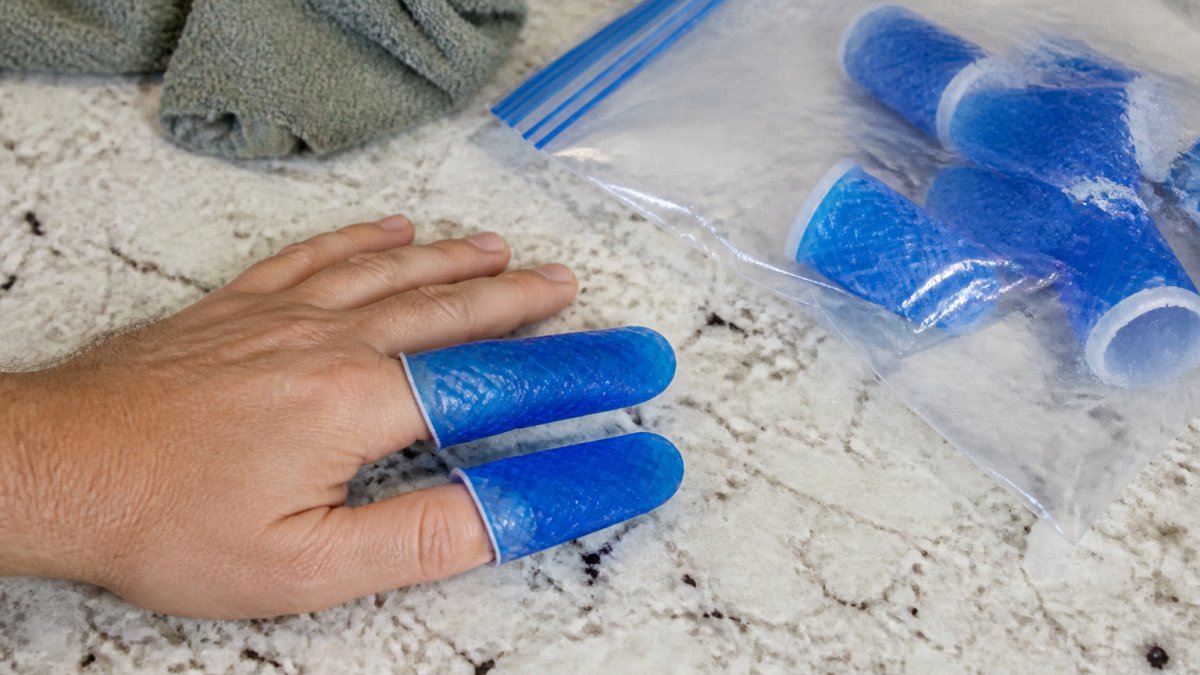
Here is the routine we recommend:
- Chill the pack first. Freeze the gel insert or refillable ice bag until cold, then let it soften for a minute so it bends.
- Slide the finger in. Push the digit into the sleeve until the cold sits over the joint, not just the tip.
- Adjust the strap or stretch. The wrap should feel snug but never pinch. You should be able to wiggle the finger.
- Set a timer for 15 to 20 minutes. Longer is not better. Cold therapy works on contact time, not endurance.
- Remove and let the skin return to normal. Wait at least an hour before repeating, and check the skin each time.
Common Mistakes That Undermine Finger Cold Therapy
The biggest mistake is icing too long. Leaving a pack on for 45 minutes because it feels good can damage skin and numb the finger past the point of usefulness. Fifteen to 20 minutes per session is the standard window.
Other common mistakes:
- Icing the wrong spot. Cold belongs over the swollen joint or tendon, not the fingertip.
- Skipping a barrier. A thin cloth between pack and skin prevents cold burns, especially with gel packs straight from the freezer.
- Refreezing a damp pack. Moisture trapped in the outer layer can weaken it over time.
Safety and Application: What the Evidence Says About Cold Therapy
Cold therapy reduces blood flow to the treated area, which is why it eases swelling and numbs pain after an injury or flare-up. That mechanism is well established, and it is why clinicians reach for cold first in the days after an acute injury.
Most product listings stop at "apply as needed." That is not enough to use cold therapy safely. Here is the application guidance those listings leave out.
Safe Application Duration
- Per session: 15 to 20 minutes. Longer is not better, cold therapy works on contact time, not endurance.
- Between sessions: Wait at least 60 minutes before repeating, and check the skin each time.
- Total daily use: For an acute injury, most practitioners find several short sessions spread across the day work better than one long one.
Skin Barriers and Protection
Always place a thin cloth between the pack and bare skin, the most effective way to prevent cold burns, especially with gel packs straight from the freezer. Check the skin every few minutes, particularly if sensation in the hand is reduced.
When to Stop or Seek Medical Advice
Stop immediately and remove the pack if you notice:
- Skin turning white, blue, or gray
- Numbness that does not fade within a few minutes of removal
- Pain that worsens instead of eases
Seek medical advice before regular cold therapy if you have diabetes, poor circulation, or reduced sensation in your hands. The CDC information on managing diabetes and nerve damage notes that reduced sensation in the feet and hands is common, which makes it harder to feel a pack that is too cold. The MedlinePlus overview of cold therapy and its uses explains that cold narrows blood vessels and can reduce inflammation and pain, while heat increases circulation, useful context for choosing which to apply.
Cold vs. Heat: A Quick Decision Rule
- Cold: fresh injuries, swollen joints, flare-ups in the first 48 hours
- Heat: stiff, tight muscles with no active swelling
- Both: a dual hot-and-cold sleeve lets you switch as your needs change without buying two products
Conclusion: Choosing the Right FreezeSleeve Alternative for Finger Relief
The right freeze sleeve alternative for finger relief is built for fingers, not borrowed from a knee or shoulder kit.
Penguin Fingers makes wearable cold compression sleeves designed for exactly this job. Our Cold Compression Gel Packs for Fingers and Toes are ultra-flexible, one-size-fits-all, non-toxic, and latex-free, so they slide over a sore finger and stay there while you get on with your day.
Get started with Penguin Fingers and put targeted, hands-free finger relief within reach.
Frequently Asked Questions
What can I use instead of a FreezeSleeve for finger relief?
A wearable gel compression sleeve sized for fingers and toes is the closest functional swap. Unlike a sleeve built for larger limbs, a finger-specific design lets you insert one or more fingers directly into the gel, so cold compression reaches the knuckles and joints without wrapping your whole hand. Look for a stretchy, latex-free material that stays flexible straight out of the freezer and covers only the digits you need treated.
What is the difference between a cold compress and a cold pack?
A cold pack is the chilled object itself, such as a gel pack or refillable ice bag. A cold compress is the act of applying cold with pressure, usually by strapping or sliding that pack against the skin. For fingers, the distinction matters: a loose gel pack slides off a knuckle, while a compression sleeve holds the cold in contact. Penguin Fingers makes a finger and toe gel pack sleeve that combines both, priced at $14.95.
How do you keep a cold pack in place on a finger?
Holding it with your other hand works for a few minutes, but not for a full 15 to 20 minute session. The practical options are a stretchy sleeve you slide the finger into, a self-adhering wrap, or a small strap. A one-size-fits-all sleeve is the least fussy, because it grips the finger on its own and frees both hands. Never tape a pack so tightly that it restricts circulation or numbs the fingertip.
How long should you apply cold therapy to a sore finger?
Most clinical guidance for cold therapy suggests sessions of roughly 15 to 20 minutes, with the skin returning to normal temperature between applications. Check your finger every few minutes, especially in the first session, since fingers are small and cool quickly. If you have nerve damage, poor circulation, or diabetes, talk to your doctor before using cold therapy, because reduced sensation makes it harder to notice tissue damage.


