

Table of Contents
- Why Movement Helps Joint Inflammation Relief
- What You'll Need Before You Start
- Low Impact Exercises for Arthritis That Target Stiff, Swollen Joints
- The Benefits of Cold Compression for Joint Pain After Exercise
- How to Manage Finger Arthritis With a Daily Routine
- Common Mistakes to Avoid
- Frequently Asked Questions
Last Updated: September 14, 2026
Why Movement Helps Joint Inflammation Relief
Joint inflammation relief rarely comes from rest alone. Motion is medicine for stiff, swollen joints: gentle movement circulates synovial fluid, nourishes cartilage, and reduces the stiffness that builds when joints sit idle. This guide from Penguin Fingers walks through the best exercises for joint inflammation relief, plus the cold compression routine that keeps swelling down afterward.

Here's the counterintuitive part. Many people with aching hands and knees assume that resting a painful joint protects it. In practice, a joint that never moves gets stiffer, weaker, and more painful over time. The muscles supporting it lose tone, and the surrounding tissue tightens. That's why physical therapists treat arthritis with movement, not bed rest.
The best exercises for joint inflammation relief share three traits: they're low impact, they stay within a pain-free range of motion, and they're done consistently rather than intensely. You are not training for a marathon. You are keeping a joint supple and its supporting muscles awake.
Below, we'll cover exactly which movements to do, how to set up before you start, and how cold compression fits into the routine so you recover instead of flare up.
What You'll Need Before You Start
You need very little equipment to begin: a chair with a firm seat, a flat surface like a table, and a warm room so your joints aren't cold and tight before you move.
A few minutes of preparation makes the difference between a helpful session and a painful one.
- A firm chair so your hips and knees stay at a comfortable 90-degree angle.
- A table or counter for seated hand and wrist work.
- A small towel or cushion to support your arm or leg if a joint needs it.
- Warmth first. A warm shower or a few minutes of heat loosens stiff tissue before you stretch.
- A cold compression sleeve on standby for afterward, when swelling tends to peak.
One rule matters more than any piece of gear: stop before pain. A gentle stretch should feel like tension, never a sharp catch. If a movement hurts, shorten the range or skip it that day.

According to guidance from the Arthritis Foundation on exercise and arthritis, low-impact activity is one of the most effective non-drug tools for managing joint pain and stiffness, which is why consistency beats intensity every time.
Low Impact Exercises for Arthritis That Target Stiff, Swollen Joints
The best low impact exercises for arthritis are the ones a stiff joint can actually tolerate: slow, controlled movements that keep the joint moving without loading it heavily.
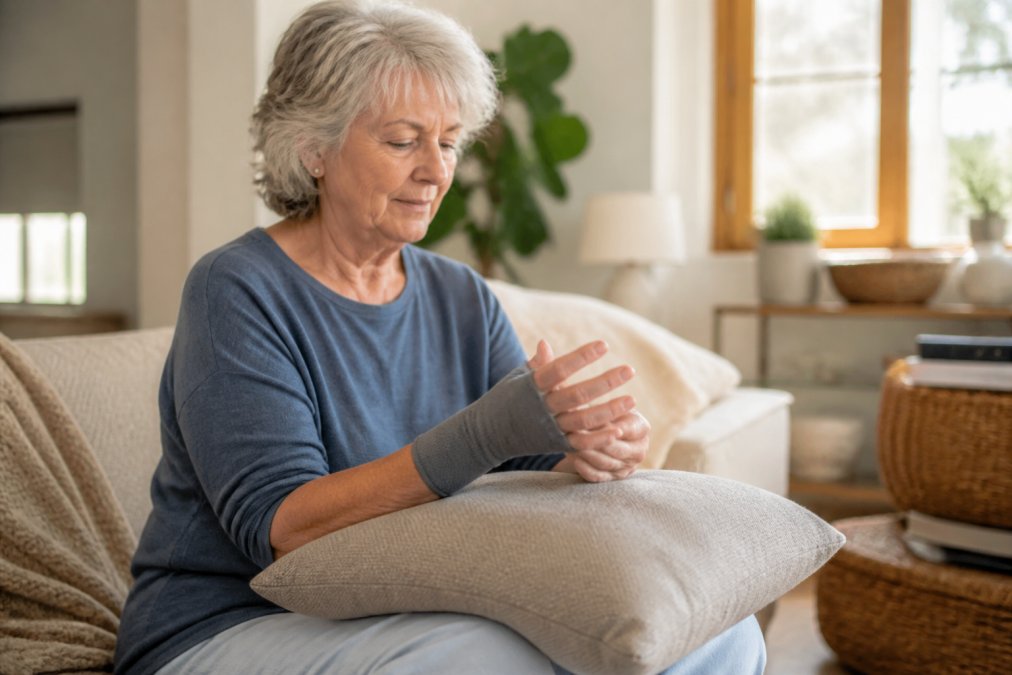
Start each session with a two-minute warm-up, then work through the movements below. Aim for 5 to 10 slow repetitions of each, once or twice a day.
Finger and Hand Exercises
Hand and finger exercises restore the grip and dexterity that arthritis erodes. Try these:
- Finger curls. Touch your thumb to each fingertip in turn, forming a gentle "O," then straighten. This keeps the small joints of the hand mobile.
- Finger fan. Rest your hand flat, then spread your fingers wide and bring them back together.
- Thumb walks. Walk your thumb across your palm to the base of your pinky and back.
- Tendon glides. Move through a hooked fist, a straight fist, and a full fist to keep the tendons gliding smoothly.
What most guides miss is how much these small movements matter for daily tasks. Grip strength is what lets you open a jar or hold a mug, and it's built through repetition, not force.
Wrist, Knee, and Ankle Movements
The larger joints respond to the same principle: move them gently through their range.
- Wrist circles. With your forearm supported, rotate your wrist slowly in both directions.
- Wrist flexion and extension. Bend the wrist gently forward, then back, stopping short of pain.
- Seated knee extensions. Straighten one leg slowly from a seated position, hold briefly, and lower.
- Ankle pumps. Point and flex your foot to keep the ankle joint and calf moving.
- Heel slides. Slide your heel toward your body while seated to gently bend the knee.
Keep every movement slow and deliberate. Speed invites strain; control builds tolerance.

The Benefits of Cold Compression for Joint Pain After Exercise
The benefits of cold compression for joint pain come down to timing: cold reduces swelling and numbs sore tissue right after activity, while the compression component helps control inflammation as the joint recovers. Consistent application of these thermal techniques serves as a foundational habit for preventing sports injuries, especially when combined with the specific movement patterns detailed in our approach to tennis injury prevention for seniors.
Exercise is good for joints, but it can leave them warm and slightly swollen for a while afterward. That's where cold compression earns its place in the routine. Applying cold to a joint after movement constricts blood vessels, which limits the swelling that causes stiffness the next day (mayoclinic.org). The compression adds gentle, even pressure that supports the joint while it settles.
For hands and fingers, this is where a wearable sleeve beats a loose ice pack. Penguin Fingers makes a finger and toe cold compression sleeve designed to slip directly onto the affected digits, so you cool and compress only where you need it instead of freezing your whole hand. The sleeve is reusable, latex-free, and flexible enough to conform to small joints, which matters when a standard ice pack is too bulky to stay put.
Use it for short sessions after exercise, not all day. A common mistake is leaving cold on too long, which can irritate skin and tissue. Keep it brief and repeat as needed.
How to Manage Finger Arthritis With a Daily Routine
Learning how to manage finger arthritis comes down to a simple daily rhythm: warm up, move gently, then cool down the swelling. Consistency across the day does more than any single long session.
A routine that works for most people looks like this:
- Morning: a warm shower, then two minutes of finger and thumb movements to shake off overnight stiffness.
- Midday: a short set of tendon glides and wrist circles at your desk.
- After activity: cold compression on the hands for a brief session to calm any swelling.
- Evening: a few slow finger curls before bed to keep the joints from tightening overnight.
The key is frequency. Short, frequent movement keeps a finger joint from seizing up, and it fits around work and daily tasks far better than one long session. If you type or grip tools all day, the midday set matters most, because that's when a hand has been held in one position the longest.
Common Mistakes to Avoid
The mistakes that slow recovery are predictable, and most of them come from doing too much too soon.
- Pushing through pain. A sharp catch is a stop signal, not a challenge. Back off the range and try again later.
- Going all-in on day one. Jumping straight into long sessions irritates joints that aren't conditioned for it. Start short and add slowly.
- Skipping the cool-down. Exercise without afterward cold compression leaves swelling unchecked, which shows up as next-day stiffness.
- Icing for too long. Cold helps in short bursts. Extended sessions can harm skin and tissue.
- Ignoring heat before movement. Cold, stiff joints don't stretch well. Warm up first.
- Treating it as one-and-done. Joint care is a routine, not an event. A little every day outperforms a lot once a week.
For anyone working through how to manage finger arthritis, the pattern is clear: warm up, move gently, cool down, repeat. The people who see the steadiest improvement are the ones who keep the routine boring and regular.
According to the CDC's overview of arthritis management, staying physically active is one of the most important things people with arthritis can do to reduce pain and improve function, and it recommends low-impact activity over inactivity.
Joint inflammation doesn't have to dictate your day. The right mix of gentle movement, a consistent daily routine, and post-exercise cold compression keeps stiff, swollen joints calmer and your hands working the way you need them to. Penguin Fingers makes wearable cold compression sleeves for fingers, toes, wrists, elbows, and knees, each designed to target a specific joint with dual hot and cold therapy. If you're ready to build a routine that actually sticks, get started with Penguin Fingers and give your joints the daily support they've been missing.
Frequently Asked Questions
What exercises should you avoid if you have joint inflammation?
Skip high-impact activities that pound the joints: running on pavement, box jumps, heavy overhead lifting, and deep lunges with added weight. These load already-swollen tissue and can extend a flare-up. Instead, choose low impact exercises for arthritis such as walking on flat ground, swimming, cycling, and gentle range-of-motion work for the fingers, wrists, and knees. If a movement causes sharp pain or swelling that lasts more than a day, drop it and try a gentler option.
How does exercise help reduce joint inflammation?
Movement keeps synovial fluid circulating, which lubricates the joint and delivers nutrients to cartilage that has no direct blood supply. Regular low-impact activity also strengthens the muscles around a joint, which takes pressure off the joint itself. The result is less stiffness in the morning, better range of motion, and often less pain over time. Pairing exercise with cold compression for joint pain after a session can further calm swelling in the hours that follow.
How often should you exercise to manage joint pain?
Most people with joint inflammation do well with 20 to 30 minutes of low-impact movement five days a week, plus a short stretching routine daily. Split it up if needed: three 10-minute sessions work as well as one long one. On flare-up days, scale back to gentle range-of-motion work rather than skipping movement entirely. Consistency matters more than intensity, so build a routine you can repeat even on a bad day.
Are there specific stretches to reduce swelling in finger joints?
Yes. Try a tendon glide sequence, moving the fingers through a straight hand, a hook fist, a full fist, and back to straight, five to ten reps per hand. Follow with a gentle finger spread and a thumb-to-each-fingertip touch. These moves pump fluid out of swollen fingers without loading the joints. Adding cold compression after stretching helps calm the tissue further, which is a practical part of how to manage finger arthritis day to day.


