

Quick Summary
Yoga poses for hand and finger mobility are slow, controlled movements that take each small joint through its full comfortable range. Doing them daily for about ten minutes can make the fingers and wrists feel more supple and less stiff in everyday tasks.
- Sit with your back supported and forearms resting, and never force a stretch.
- Do wrist circles, Gyan Mudra holds and finger spread-and-close moves, repeating each 5 to 8 times.
- Start with one 10-minute round per day, then add a round or more reps in week two.
- Stop if you feel sharp pain, and skip loading moves on a hot, red or swollen joint.
- Check with your doctor or a hand therapist before starting if you have arthritis, carpal tunnel or a recent injury.
Table of Contents
- Why Yoga Helps Hand and Finger Mobility
- Before You Start: Setup, Safety, and When to Stop
- Hand Yoga Poses with Names and Step-by-Step Instructions
- Finger Yoga Exercises for Daily Practice
- Beginner Routine: A Progressive 10-Minute Sequence
- Hand Yoga for Arthritis: Modifications and Limits
- Start Your Daily Hand Routine Today
- Frequently Asked Questions
Why Yoga Helps Hand and Finger Mobility
Stiff fingers and wrists make everyday tasks harder than they should be. If morning finger stiffness is the problem, read this guide to relief for finger joint stiffness in the morning.
Hand yoga works because it asks each joint to move through its full range, gently and often. A 2025 review of prospective studies on yoga for musculoskeletal disorders looked at how yoga affects the musculoskeletal system, though the research we reviewed does not report a specific finding for finger-only poses.
So what does a hand routine actually do? It works on three things:
- Range of motion: moving each joint through its full, comfortable arc
- Flexibility: lengthening the muscles that open and close the hand
- Control: coordinating small movements, like spreading and closing the fingers
Think of it as stretching for the hands. It will not fix a serious joint condition on its own, but it is a simple habit that many people find useful for staying mobile.
Before You Start: Setup, Safety, and When to Stop
Set yourself up for success before the first pose. Sit in a chair with your back supported and your feet flat on the floor. Rest your forearms on a table or your thighs so your wrists stay relaxed.
Keep these safety rules in mind:
- Move slowly. Never force a stretch or bounce into it.
- Stop if you feel sharp pain. Mild stretching is fine. Sharp or pinching pain is your cue to stop.
- Go easy on swollen joints. If a joint is hot, red or puffy, skip the hard poses that day.
Watch out: pushing through pain in a stiff, swollen knuckle can irritate the joint and make it feel worse the next day. For practical steps, see how to reduce finger arthritis swelling fast. To compare options for joint support during hand exercises, see finger splints for arthritis support.
If you have a condition such as arthritis, carpal tunnel or a recent injury, check with your doctor or a hand therapist before you start a new routine.
Hand Yoga Poses with Names and Step-by-Step Instructions
Each pose below uses simple, everyday movements. Repeat each one 5 to 8 times, then rest your hands for a few seconds.
Wrist Circles and Wrist Rotations
Wrist work is the foundation of any hand routine, because the wrist controls how freely the fingers move.
- Extend your arms in front of you with your palms facing down.
- Make a loose fist and slowly rotate your wrists in one direction for 5 circles.
- Reverse the direction for another 5 circles.
- Turn your palms up and bend your wrists gently up and down.
Expected result: Your wrists feel looser and less tight when you begin typing or writing.
Gyan Mudra and Finger Extensions
Gyan Mudra is a classic seated hand position in yoga. It pairs well with finger extensions to open up the fingers.
- Rest your hands on your knees, palms facing up.
- Touch the tip of your index finger to the tip of your thumb, and keep the other three fingers gently extended.
- Hold for 30 seconds, breathing slowly.
- Next, spread all five fingers wide, hold for 5 seconds, then close them softly into a loose fist.
- Repeat the spread and close 5 times.
Expected result: Your fingers feel lighter and easier to open fully.
Finger Yoga Exercises for Daily Practice
Short daily finger work often beats one long session each week. Try these quick exercises whenever you take a break from your phone or keyboard.
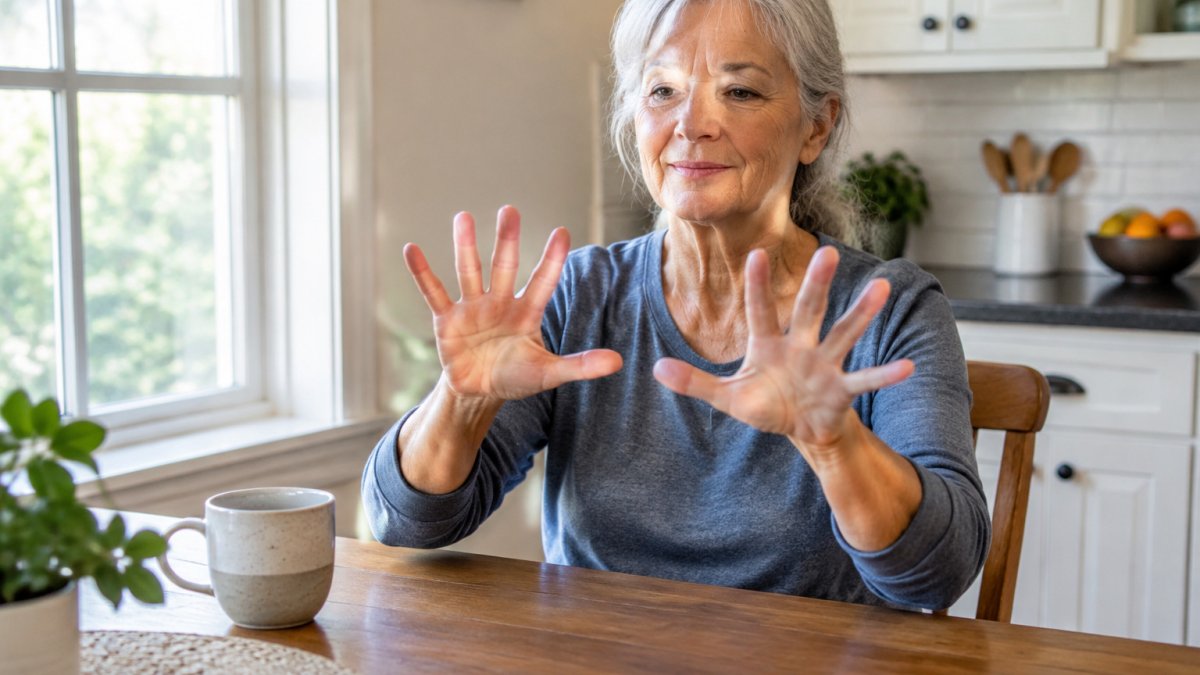
- Tabletop press: Place your palms flat on a table with fingers straight, then lift each finger one at a time and lower it back down.
- Hook fist: Bend your fingers into a relaxed hook shape and hold for 5 seconds. Then straighten them fully.
- Finger walks: Walk your fingers slowly across the table, one at a time, to build control.
Beginner Routine: A Progressive 10-Minute Sequence
This sequence combines the moves above into one session with suggested repetitions, holds, rest periods, and a clear way to progress. It is built for a 10-minute block, but you can shorten it to 5 minutes on busy days by doing one round instead of two.
Before you begin: Sit with your back supported and your feet flat. Rest your forearms on a table or your thighs. Have a small pillow nearby if your wrists need support.
The Sequence
- Warm-up (2 minutes): Wrist circles, 5 in each direction per hand. Then gentle wrist up-and-down bends, 5 per hand. Rest 10 seconds.
- Open the hands (2 minutes): Gyan Mudra hold for 30 seconds per hand, breathing slowly. Then finger spread-and-close, 5 cycles per hand. Rest 15 seconds.
- Load and control (3 minutes): Tabletop press, lifting each finger one at a time, 5 lifts per hand. Then hook fist, hold 5 seconds, straighten fully, 5 repetitions per hand. Rest 20 seconds between the two moves.
- Cool-down (2 minutes): Gentle hand shake for 20 seconds, then a relaxed open-palm hold for 20 seconds per hand. Finish with 3 slow breaths.
Total time: About 10 minutes, including rest.
Penguin Fingers Cold Compression Gel Packs for Fingers and Toes →
How to Progress
Start with one round per day for the first week. Use these checkpoints to decide when to add more:
- Week 1: One round, 5 repetitions per move, 30-second holds. Stop if any move causes sharp pain.
- Week 2: If your hands feel comfortable the next day, add a second round or increase to 8 repetitions per move. Keep holds at 30 seconds.
- Week 3 and beyond: Add a second round if you have time, or increase holds to 45 seconds for the Gyan Mudra and open-palm positions. Do not increase repetitions and holds in the same week.
A common pattern is to advance too quickly because the moves feel easy. The hands do not need to be tired to benefit; they need to move often.
Watch out: Do not use the routine to push through a swollen or hot joint. On flare days, do only the warm-up and cool-down stages, and keep every movement within a comfortable range.
Rest and Recovery
Rest periods are part of the routine, not a break from it. Aim for 10 to 20 seconds between moves and a full minute between rounds. Giving your hands enough time to recover between rounds also makes it easier to warm up fingers before a more demanding activity like climbing.
The progression below summarises how to build the 10-minute routine week by week.
| Week | Routine | Holds and repetitions |
|---|---|---|
| Week 1 | One round per day | 5 repetitions per move, 30-second holds |
| Week 2 | Add a second round or more reps | 8 repetitions per move, 30-second holds |
| Week 3 and beyond | Add a second round or longer holds | Holds increased to 45 seconds; do not raise reps and holds in the same week |
| Sequence total | About 10 minutes including rest | Rest 10 to 20 seconds between moves, 1 minute between rounds |
Hand Yoga for Arthritis: Modifications and Limits
Hand yoga can be a gentle way to keep moving if you have arthritis, but it is not a single routine for everyone. The right approach depends on the type of arthritis, whether a joint is inflamed, and whether you have nerve symptoms. This section covers the modifications and limits that matter most.
Match the Modification to Your Situation
- Osteoarthritis (wear-and-tear): Gentle movement within a comfortable range is usually well tolerated. Focus on wrist circles, finger spreads, and open-palm holds. Avoid long holds on a joint that feels grating or sharp.
- Rheumatoid arthritis or other inflammatory types: Skip loading poses during a flare. When joints are hot, red, or puffy, do only gentle range-of-motion moves such as wrist circles, and keep the hands supported on a pillow. Return to the fuller routine only when swelling settles.
- Recent injury or surgery: Do not start a hand yoga routine until your doctor or hand therapist clears you. Follow their range-of-motion limits exactly, even if a pose feels easy.
Accessible Modifications for Different Mobility Levels
If you cannot bear weight through your hands or fully extend your fingers, use these alternatives:
- Seated and supported: Rest your forearms on a table or a pillow for every move. Do wrist circles with your hands relaxed, not fisted.
- Low-load finger work: Instead of a tabletop press, place your palm on a soft surface such as a folded towel and lift each finger a small distance. The goal is movement, not force.
- Partial-range spreads: Open your fingers only as far as comfortable, then close softly. Do not force a full spread.
Limits and When to Seek Advice
Yoga cannot reverse arthritis damage, and it is not a replacement for medical care. Use these limits as a guide:
- Stop if pain is sharp or pinching. Mild stretching is fine; sharp pain is not.
- Do not hold stretches on an inflamed joint. Keep holds short or skip them on flare days.
- Watch for next-day worsening. If stiffness or swelling is worse the day after a session, reduce the routine and give the hands a rest day.
Watch out: A routine that feels fine during a flare can increase swelling later. On flare days, choose the seated, supported options and keep the session to 5 minutes.
Tracking Progress Without Diagnosing
You do not need to measure anything to know whether the routine is helping. A simple note after each session is enough: rate your hand stiffness on a 0-to-10 scale, and write down one daily task you noticed, such as opening a jar or typing comfortably. Over two to three weeks, look for a pattern of easier movement or less morning stiffness.
Start Your Daily Hand Routine Today
Pick the beginner sequence above and do it once today. That single session is enough to start a habit. Keep your sessions short, your movements slow, and your breathing steady.
If your fingers feel sore after you practice, a wearable cold compression sleeve can be an option to consider. The Penguin Fingers Cold Compression Gel Pack for Fingers and Toes is designed to insert a finger or toe, with a flexible, latex-free sleeve that costs $14.95.

Last Updated: November 4, 2026
Frequently Asked Questions
What yoga poses help improve hand and finger mobility?
Poses that work well for hand and finger mobility include Gyan Mudra, tabletop hand presses with straight fingers, wrist circles, finger extensions, and the hook fist and full fist variations. Each targets a different range of motion: wrist rotations loosen the wrist joint, while finger extensions and spreads work the small joints of the fingers. Hold each position for 3 to 5 breaths and repeat 3 to 5 times. Start with the poses that feel comfortable and add more challenging variations as your mobility improves.
How often should you do hand yoga exercises?
Most people benefit from practicing hand yoga once or twice a day for about 5 to 10 minutes. Short, frequent sessions tend to be more effective than one long session each week, because joints respond well to consistent gentle movement. Many people find it helpful to do a routine in the morning to loosen stiffness and again in the evening after long periods of typing or using a phone. Stop if you notice sharp pain or swelling.
Is hand yoga suitable for older adults with arthritis?
Hand yoga can be suitable for adults over 50 with arthritis in the fingers, but movements should be gentle and pain-free. Use smaller ranges of motion, skip any position that causes sharp pain, and consider performing the moves with warm water or a warm towel beforehand. Penguin Fingers offers cold compression gel packs for fingers and toes. If your joints are swollen or hot, check with a healthcare provider before starting a new routine.
When should you stop hand exercises if your fingers hurt?
Stop any hand exercise if you feel sharp pain, numbness, tingling, or increased swelling. Mild stretching sensations are normal, but pain that lingers for more than a few hours after practice is a sign to reduce intensity or stop. Rest the affected hand, switch to gentler movements such as slow wrist circles, and see a doctor if symptoms persist or worsen over several days.


