

Table of Contents
- Why Your Fingers Feel Stiff Every Morning
- Stiffness or Locking? Telling Joint Stiffness From Trigger Finger
- Morning Finger Stiffness Exercises: A 10-Minute Routine
- Heat or Cold for Stiff Finger Joints: Which to Use and When
- Overnight Habits and Ergonomics That Reduce Morning Stiffness
- When to See a Doctor for Stiff Fingers
- Track Your Symptoms to Find What Works
- Conclusion
- Frequently Asked Questions
Last Updated: October 17, 2026
Why Your Fingers Feel Stiff Every Morning
Waking up with finger joint stiffness is common, and the cause usually falls into one of two groups: joint wear or soft-tissue inflammation. Most people can ease finger joint stiffness with a short daily routine, better overnight habits, and the right heat or cold.
The pattern matters more than the stiffness itself: morning finger stiffness that fades within 30 minutes points toward a different cause than stiffness that lingers an hour or more.
Arthritis and Joint Wear
Osteoarthritis is the wear-and-tear form of hand arthritis and the most common reason fingers feel stiff after sleep. The cartilage cushioning finger joints thins over time, so joints feel tight and sore until movement gets fluid moving again.
Signs that point to joint wear rather than soft tissue:
- Stiffness centered on the knuckles and the joint nearest the fingertip
- Bony bumps forming at the joint edges
- Reduced range of motion that improves with use
Inflammation, Tendons, and Trigger Finger
Inflammation in the tendons or joint lining can cause morning stiffness too.
Tendon-related stiffness feels like tightness along the finger or palm that eases once the tendon warms up. A trigger finger is a specific tendon problem: the finger catches or locks when you bend it, then pops straight, because a swollen tendon catches on its sheath, not the joint itself.
Other causes of stiff fingers in the morning include:
- Swelling and tenderness around the joints
- Overuse from gripping, typing, or climbing the day before
- Fluid retention that settles in the hands overnight
Stiffness or Locking? Telling Joint Stiffness From Trigger Finger
Joint stiffness is general tightness across the finger that loosens with movement; trigger finger is a catching or locking sensation at one specific spot, usually the base of the finger.
Here's how to tell them apart:
| Feature | Joint Stiffness | Trigger Finger |
|---|---|---|
| Feeling | Tight, achy, hard to bend | Catching, popping, locking |
| Location | Whole joint or several fingers | One finger, base of the finger |
| With movement | Eases as you move | May click or stick when bending |
| Best early response | Heat and gentle stretching | Rest and medical evaluation |
If one finger snaps or locks and you have to force it straight, that's a tendon issue, not simple stiffness. Trigger finger often needs a doctor's input, especially if it keeps locking.
Morning Finger Stiffness Exercises: A 10-Minute Routine
Morning finger stiffness exercises work best when they're gentle, done before you start your day, and repeated at the same time each morning.
Warm up first. Run warm water over your hands for a minute, or hold a warm mug for two minutes.
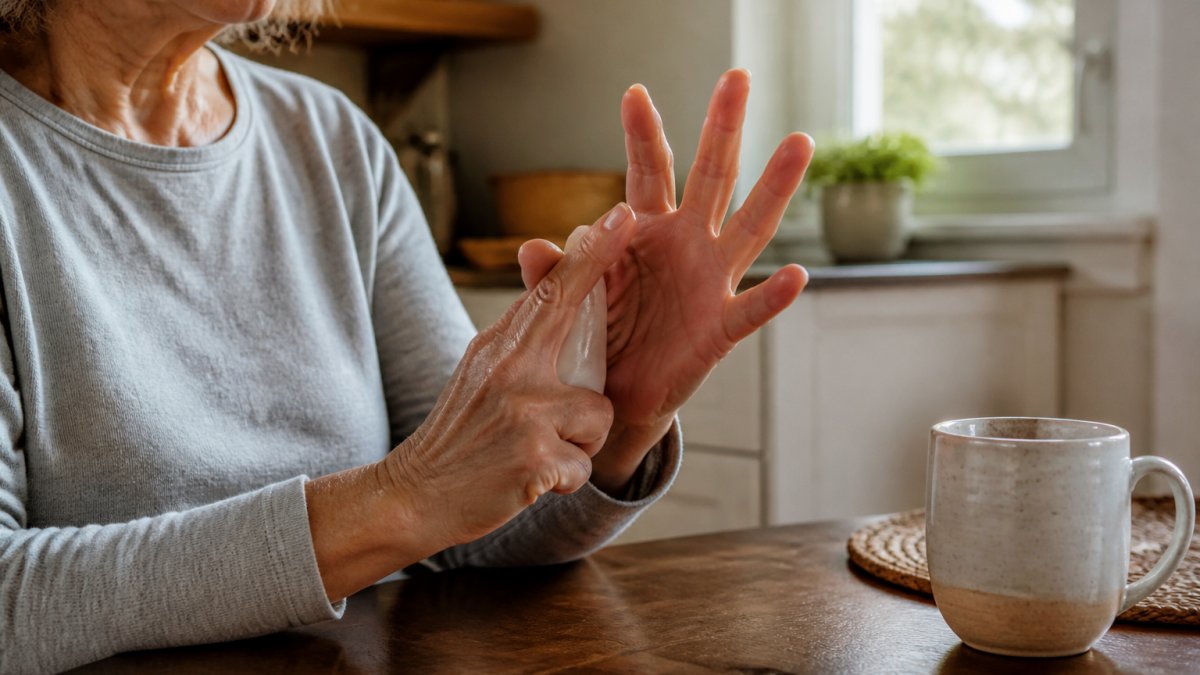
Step-by-Step: Table Bends, Fist Formation, and Tendon Gliding
Do each exercise slowly and breathe normally. Stop if you feel sharp pain, a gentle stretch is the target, not a strain. If a joint is swollen or hot, skip stretching and use cold instead.
- Table bends (1 minute). Place your palm flat on a table, fingers spread. Lift each finger off the surface one at a time, hold for one second, then lower it. Five lifts per finger, both hands. Keep the palm down, if the whole hand lifts, press the palm gently into the table.
- Finger bends (1 minute). Hold your hand up, palm facing you. Bend each finger down toward your palm one at a time, then straighten it fully. Five reps per finger. Don't use the other hand to push a finger further than it wants to go.
- Fist formation (1 minute). Slowly curl your fingers into a loose fist, thumb outside the fingers, not tucked under them, hold for two seconds, then open the hand wide, spreading the fingers. Ten reps. The open phase matters as much as the close.
- Tendon gliding (2 minutes). Move through five hand shapes in sequence: straight hand, hook fist (fingers bent at the top joints only), full fist, tabletop (fingers bent at the knuckles, straight at the top joints), and straight fist (fingers straight, knuckles bent). Hold each shape for two seconds, then move to the next. Three full sequences per hand.
- Wrist and thumb circles (1 minute). Rotate each wrist five times in each direction, then circle each thumb five times in each direction. Keep the circles small and slow.
- Warm soak finish (3 minutes). End with a warm water soak to relax muscles and keep joints loose. Dry hands thoroughly and flex them a few times before you start your day.
Do this routine daily, ideally at the same time each morning.
Modifications When Hands Are Very Stiff or Sore
Use these adjustments instead of pushing through:
- Very stiff, no swelling: extend the warm-up to three minutes and cut reps in half. Add reps back as the hands loosen.
- Swollen or hot joints: skip steps 1-5 and use a cold pack for 10 minutes instead. Stretching an inflamed joint can increase swelling.
- After a flare: start with tendon gliding only, two sequences per hand, for two or three days before returning to the full routine.
Stop any exercise that causes sharp pain, numbness, or tingling that lasts more than a minute. Soreness that fades within a few minutes is normal; pain that builds is a signal to back off and, if it persists, to ask a clinician.
Heat or Cold for Stiff Finger Joints: Which to Use and When
Use heat for stiffness and cold for swelling. Heat relaxes muscles and loosens stiff joints, making it the better choice for morning tightness. Cold calms inflammation and numbs pain, suiting a joint that's hot, swollen, or flared up.
Here's how to choose:
- Warm water soak: best for general morning stiffness. Soak hands for 5-10 minutes.
- Warm compress or heating pad: good before exercise or after a long day.
- Ice pack or cold therapy: best after activity, for swelling, or for a flare.
The Arthritis Foundation's guidance on heat and cold recommends heat for stiffness and cold for inflammation and pain. Which one you reach for depends on what your hands are doing that day.
For cold therapy, a wearable sleeve beats a loose ice pack because it stays put and targets just the fingers. Our Penguin Fingers Cold Compression Gel Packs for Fingers and Toes slide over the finger or toe for targeted cold compression, and the flexible design fits any finger size.
Penguin Fingers Cold Compression Gel Packs for Fingers and Toes →

Overnight Habits and Ergonomics That Reduce Morning Stiffness
What you do before bed shapes how your hands feel at sunrise. Small changes to overnight positioning and daily ergonomics can reduce morning stiffness over time.
Try these habits:
- Keep hands warm overnight. Cold rooms tighten joints and muscles.
- Avoid sleeping with hands curled tightly under your pillow or body.
- Use a night splint if a doctor recommends one for positioning.
Going all day without a break builds up overuse. Brief, frequent breaks do more for hand mobility than one long rest.
When to See a Doctor for Stiff Fingers
See a doctor when stiffness lasts more than an hour most mornings, when joints are hot and swollen, or when stiffness comes with other symptoms. An evaluation helps rule out inflammatory arthritis and other conditions that need treatment.
Inflammatory vs. Mechanical Stiffness
Clinicians often sort morning stiffness into two broad patterns. The distinction isn't a diagnosis, but it guides what gets checked first.
- Mechanical pattern (more common with osteoarthritis): stiffness that lasts minutes to about 30 minutes, eases with movement, and is worse after heavy use the day before. Joints may ache but are usually not hot or red.
- Inflammatory pattern: stiffness that lasts an hour or longer, improves with activity but returns after rest, and often comes with swelling, warmth, or redness. Stiffness in the same joints on both hands, or in the small joints of the fingers and wrists, is a pattern worth mentioning.
People often notice the duration creeping up over weeks, 15 minutes becomes 30, then 45. That trend is more informative than any single morning, which is why tracking helps.
What a Clinician Will Likely Check
A clinician will typically:
- Ask how long stiffness lasts, which joints are involved, and whether it is symmetric
- Examine the hands for swelling, warmth, bony bumps, and range of motion
- Check for triggering or locking in individual fingers
Most of this is a conversation plus a hands-on exam. The history you provide is often the most valuable part.
How to Prepare for the Visit
Bring specifics, not a general description:
- Duration: how many minutes stiffness lasts on a typical morning, and the worst and best mornings in the past two weeks
- Which joints: left, right, or both; fingers, knuckles, wrists, or thumb base
- Swelling or heat: whether joints look or feel puffy, warm, or red
A two-week symptom log (see the tracking section below) covers all of this in one page.
Red Flags That Warrant Prompt Attention
Watch for these signs and mention them when you call:
- Morning stiffness lasting an hour or longer, most days
- Swelling, warmth, or redness in the joints
- Stiffness in the same joints on both hands
The American College of Rheumatology's guidance on osteoarthritis notes that persistent joint symptoms deserve a proper exam. Early treatment protects joint function. Don't wait for stiffness to become constant pain.
Track Your Symptoms to Find What Works
Tracking turns guesswork into a plan. Note your stiffness each morning and what you did the day and night before, patterns show up fast.
Use this simple template:
| What to Track | How to Record It | Why It Matters |
|---|---|---|
| Stiffness duration | Minutes until hands feel normal | Shows whether things improve |
| Which fingers | Left, right, or both | Reveals patterns |
| Swelling or heat | Yes or no | Flags inflammation |
| Overnight habits | Splint, temperature, position | Links habits to results |
| Yesterday's activity | Typing, gripping, exercise | Spots overuse triggers |
| What helped | Heat, cold, stretching | Confirms what works |
Fill it in for two weeks and bring it to your doctor if symptoms persist, real data beats a vague description.
Conclusion
Morning finger stiffness is common, and most cases ease with a steady routine: warm up, stretch gently, choose heat for stiffness and cold for swelling, and adjust your overnight habits.
At Penguin Fingers, we build wearable cold compression sleeves for exactly this kind of daily relief. Our dual hot and cold therapy options target specific body parts, and our flexible, latex-free designs fit fingers of all sizes.
Frequently Asked Questions
How do I stop my fingers from being stiff in the morning?
Start with a warm water soak for 5 minutes, then run through gentle range-of-motion exercises like table bends and fist formation before you grip anything. Keep your hands warm overnight and avoid sleeping with them curled tight. If finger joint stiffness lasts more than 30 to 60 minutes most mornings, or comes with swelling and tenderness, get it checked, because that pattern points toward arthritis rather than simple inactivity.
What exercises help loosen stiff fingers in the morning?
Try table bends (lay your hand flat, lift each finger one at a time), fist formation (curl slowly into a loose fist, hold 2 seconds, release), and tendon gliding (move through a hooked fist, straight fist, and flat hand). Do 8 to 10 slow reps of each. Warmth first makes the stretches more comfortable. Stop if you feel sharp pain rather than a stretch, and never force a joint that feels locked.
Can heat or cold help with stiff finger joints?
Heat works best for morning stiffness because it increases blood flow and relaxes muscles around the joint, so a warm water soak or warm compress before exercise is a good first step. Cold therapy is better after activity or when a joint is swollen and hot. A wearable cold compression sleeve such as Penguin Fingers' finger and toe gel pack ($14.95) lets you apply cold only where you need it without freezing your whole hand.
When should I see a doctor about morning finger stiffness?
Book an appointment if stiffness lasts longer than an hour most mornings, affects the same joints on both hands, or comes with swelling, redness, warmth, or reduced range of motion that does not improve. Also see a doctor if a finger locks or catches, if you have numbness, or if self-care has not helped after a few weeks. Early evaluation matters because inflammatory arthritis is easier to manage when treated sooner.


