

Table of Contents
- What to Look for in Finger Splints for Arthritis
- Finger Splint Types and Uses: Which Design Fits Your Condition
- Finger Splint Sizing: How to Measure for a Snug, Safe Fit
- How Long to Wear a Finger Splint for Arthritis
- When to Use Cold Compression Instead of a Splint
- Common Mistakes That Make Arthritis Splints Less Effective
- When to See a Doctor About Finger Arthritis
- Conclusion: Matching Splint to Symptom
- Frequently Asked Questions
Last Updated: October 13, 2026
What to Look for in Finger Splints for Arthritis
The best finger splints for arthritis support share three traits: light weight, adjustable fit, and firm joint stability without cutting off circulation.
Arthritis in the fingers rarely affects every joint the same way.
At Penguin Fingers, we build wearable cold compression therapy for sore, swollen joints, and we hear one question constantly: how do I pick the right support?

Material and Weight
Lightweight materials win for daily wear. Neoprene and soft fabric blends feel comfortable against the skin and flex with your hand, while metal or plastic supports hold a joint in a fixed position.
Weight matters more than shoppers expect: a splint that feels fine for ten minutes can ache after three hours of typing or cooking. For daytime wear, favor a fabric or foam design.
Adjustability and Fit
Adjustable closures let you loosen a splint when swelling rises and tighten it when inflammation settles. Swelling in arthritic fingers changes through the day, often worse in the morning and after activity.
Look for straps, hook-and-loop tabs, or a molded design that hugs the finger without pinching. A splint that cannot be adjusted will feel loose by afternoon or leave red marks by lunch.
Finger Splint Types and Uses: Which Design Fits Your Condition
Each finger splint design solves a different problem. Ring splints support hypermobile or unstable joints, gutter splints immobilize a sprained or fractured finger, and mallet finger splints hold the fingertip straight. Matching the design to your condition is the most important decision you will make.
Ring Splints for Arthritis
Ring splints for arthritis are small loops, often metal or plastic, that sit around a finger joint and hold it in proper alignment. They work well for osteoarthritis and rheumatoid arthritis because they keep the joint from drifting sideways or hyperextending.
Most ring splints are worn on the middle joint and stay in place during typing, writing, and light gripping. They are subtle, which matters if you are self-conscious about visible supports.
Gutter, U-Shaped, and Mallet Finger Splints
Gutter splints cradle the finger along its length to limit bending.
U-shaped splints wrap around the top and sides of a finger, leaving the palm side open, offering moderate support for arthritis and mild injuries without fully locking the joint.
Mallet finger splints hold the fingertip joint straight so the tendon can heal after the tip droops and cannot straighten on its own.
| Splint Type | Best For | Support Level | Typical Wear |
|---|---|---|---|
| Ring splint | Arthritis, hypermobility, alignment | Moderate | Daytime tasks |
| Gutter splint | Sprains, fractures, boxer's fracture | Firm | Continuous during healing |
| U-shaped splint | Mild arthritis, tendon irritation | Light to moderate | As needed |
| Mallet finger splint | Dropped fingertip tendon injury | Firm, fixed | Continuous for weeks |
Finger Splint Sizing: How to Measure for a Snug, Safe Fit
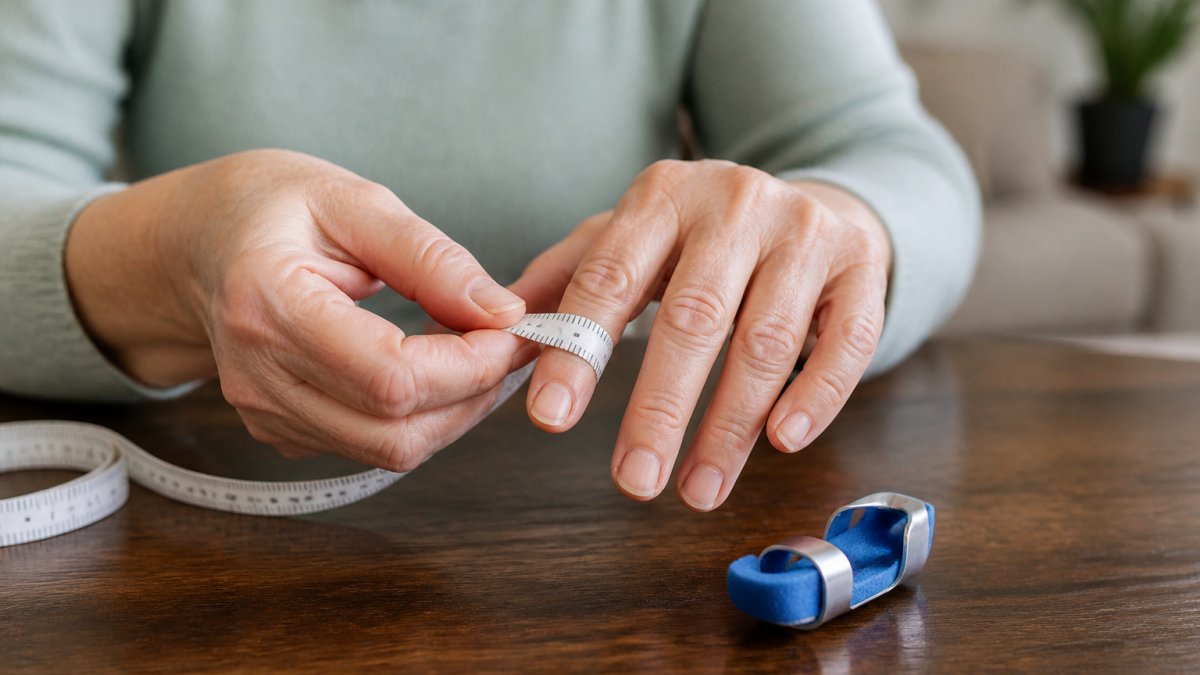
A properly sized finger splint should feel snug but never painful, and it should not leave deep marks or turn your fingertip pale. Sizing is where most returns happen, so measure the finger you actually plan to splint, not a neighboring one.
How to Measure Finger Circumference
Use a soft measuring tape, or a strip of paper you mark and lay flat against a ruler. Wrap it around the finger at the joint you are splinting, at its widest point, usually right over the swollen knuckle, snug but not indenting the skin.
For a ring splint, measure at the joint the ring will sit on, not the base of the finger.
Finger Splint Size Chart
Most manufacturers publish their own size chart, and millimeter ranges differ between brands. Use the chart below as a starting reference, then confirm against the specific product's chart before ordering.
| Size | Finger circumference at the joint | Typical finger |
|---|---|---|
| XS | Under 44 mm | Pinky, small ring finger |
| S | 44-48 mm | Ring finger, index finger |
| M | 48-53 mm | Index finger, middle finger |
| L | 53-58 mm | Middle finger, thumb base |
| XL | Over 58 mm | Thumb, swollen joints |
If your measurement falls between two sizes, size up for a rigid splint and size down for a soft fabric splint, which stretches slightly with wear.
The Circulation Check
After you put the splint on, press the tip of your finger until it blanches white, then release. Color should return within about two seconds.
Check circulation again after ten minutes and again after an hour. Swelling in arthritic fingers changes through the day, so a splint that fit at 8 a.m. can be tight by noon.
Signs Your Splint Is Too Loose or Too Tight
Too tight: fingertip turns pale or blue, tingling or numbness, throbbing at rest, deep lasting marks, skin breakdown, or a finger colder than its neighbors.
Too loose: the splint slides or rotates during typing or gripping, the joint still bends when it should be held, or you must re-tighten it several times a day.
If you cannot find a size that fits without pinching, ask a hand therapist about a custom-molded splint.
Penguin Fingers Cold Compression Gel Packs for Fingers and Toes →
How Long to Wear a Finger Splint for Arthritis
There is no single answer. How long to wear a finger splint for arthritis depends on the joint, the type of arthritis, your pain pattern, and whether you are recovering from an injury or managing a long-term condition. The table below gives common patterns, but your clinician sets the schedule for your hand.
| Situation | Typical wear pattern | Notes |
|---|---|---|
| Osteoarthritis, painful knuckle | During activities that trigger pain; off at rest | Ring splints are often worn most of the day |
| Rheumatoid arthritis flare | Short, frequent intervals; remove if swelling rises | Adjustable closures matter most here |
| Painful knuckles, no diagnosis yet | Activity-specific only until evaluated | Do not self-treat a hot, swollen joint |
| Mallet finger | Continuously for several weeks, including sleep | The fingertip joint must stay straight |
| Sprain or stable fracture | Continuous during healing, per clinician | Timeline is set by the treating provider |
| Post-surgical | Per surgeon's protocol | Do not change the schedule on your own |
Daytime Versus Nighttime Wear
For everyday arthritis, many people wear a splint during activities that trigger pain, typing, gardening, gripping tools, opening jars, and remove it at rest. This protects the joint when it works hardest without letting the finger stiffen from round-the-clock immobilization.
Nighttime is different. A rigid splint worn overnight can become too tight as swelling increases during sleep, and a finger immobilized for eight hours can feel stiff in the morning.
When to Remove a Splint
Take the splint off to:
- Wash and dry the finger and the splint
- Check the skin for redness, blisters, or breakdown
- Re-check circulation after swelling changes
A practical rule: if the splint reduces pain and lets you do more, keep wearing it during those activities. If it causes stiffness, muscle weakness, or skin irritation, cut back and talk to a clinician. Prolonged immobilization can weaken the muscles that move the finger and stiffen the joint, so a splint is a tool for specific tasks, not a permanent fixture.
When to Seek Professional Guidance on Wear Time
Ask a clinician or hand therapist about your wear schedule if:
- Pain is not improving after a few weeks of splinting
- The finger is stiffening rather than loosening
- You cannot tell whether the joint is stable enough to use without the splint
A hand therapist can fit the splint, teach you a wear schedule, and show you exercises to keep the finger moving while supported. The Arthritis Foundation and the National Institute of Arthritis and Musculoskeletal and Skin Diseases both publish general guidance on managing joint symptoms that pairs well with a clinician's plan.
When to Use Cold Compression Instead of a Splint
Cold compression helps most when the joint is hot, swollen, and throbbing. A splint helps when the joint needs support and alignment.
Cold therapy narrows blood vessels and calms inflammation, which is why it feels so good on a flare-up.
The Penguin Fingers finger and toe cold compression sleeve slides over the finger so you can ice a single joint without freezing your whole hand.
In practice, a common pattern is cold compression for the first day or two of a flare, then a splint for support once swelling settles.
Common Mistakes That Make Arthritis Splints Less Effective
The biggest mistake is buying a splint that is too tight. A splint that pinches does not support better; it hurts, reduces circulation, and can make swelling worse.
Other frequent errors:
- Wearing a rigid splint nonstop and letting the finger stiffen
- Skipping sizing and guessing at finger circumference
- Using a splint meant for a different joint or condition
What most guides miss is that a splint is a tool, not a treatment. It manages symptoms and protects the joint while you address the underlying condition with your care team.
When to See a Doctor About Finger Arthritis
See a doctor if finger pain is severe, a joint is red and hot, you cannot move the finger, or symptoms worsen instead of improving.
Get evaluated promptly after any injury where the finger looks deformed, points the wrong way, or will not straighten.
For ongoing arthritis, a clinician can confirm the type, recommend splinting schedules, and connect you with physical or occupational therapy.
Conclusion: Matching Splint to Symptom
Picking a finger splint comes down to matching the design to your symptom: ring splints for alignment and arthritis, gutter and mallet splints for injuries, and cold compression for hot, swollen flares. Measure carefully, check circulation, and adjust as swelling changes.
Frequently Asked Questions
What is the best finger splint for arthritic fingers?
The best finger splints for arthritis depend on which joints are affected and how much support you need. Ring splints work well for mild to moderate arthritis in the middle joints, while gutter splints offer more rigid support for unstable or painful joints. Look for lightweight, adjustable designs with soft edges.
Can wearing a finger splint make arthritis worse?
Wearing a splint incorrectly or for too long can weaken surrounding muscles and stiffen joints, which may worsen symptoms over time. Splints should support, not immobilize completely. Remove them for gentle range-of-motion exercises daily. If you notice increased stiffness, swelling, or skin irritation, stop wearing the splint and consult a hand therapist. The goal is to protect joints during flare-ups while keeping them mobile between episodes.
How long should you wear a finger splint for arthritis?
Most people wear finger splints for arthritis during flare-ups or activities that strain the joints, often 2 to 4 hours at a time. Some wear them overnight to prevent morning stiffness. Your doctor or hand therapist may recommend longer periods if you have severe joint instability. Start with short intervals, check circulation every hour, and adjust based on comfort and symptoms. Never wear a splint continuously for more than 24 hours without medical guidance.
Are ring splints effective for arthritis?
Ring splints can be effective for arthritis, especially for hypermobility and mild joint misalignment. They support the joint without covering the whole finger, allowing more dexterity than bulkier splints. However, they work best for specific joint problems and may not help severe deformities or acute inflammation.
Finger arthritis is stubborn, and no single product fixes it. What works is a routine that protects the joint, calms inflammation, and keeps your hands moving. Penguin Fingers makes wearable cold compression sleeves for fingers and toes, with dual hot and cold therapy and a flexible, latex-free design that reaches the joint you need. Get started with Penguin Fingers and give sore, swollen fingers the targeted relief they have been missing.


