

Table of Contents
- What Tendonitis Is and Why Home Treatment Works
- The RICE Method for Tendonitis: Your First Line of Defense
- Step-by-Step: How to Treat Tendonitis at Home
- How Long Does Tendonitis Take to Heal?
- Best Cold Compression Sleeves for Tendonitis
- Preventing Flare-Ups: Ergonomics for Desk Workers and Athletes
- When to See a Doctor (and What Not to Do)
- Frequently Asked Questions
Last Updated: September 22, 2026
What Tendonitis Is and Why Home Treatment Works
Tendonitis is inflammation of a tendon, the band connecting muscle to bone. It causes acute pain, swelling, and stiffness around joints like the wrist, elbow, ankle, or shoulder, usually from repetitive strain rather than a single injury.
The RICE Method for Tendonitis: Your First Line of Defense
The RICE method for tendonitis is the standard first response for new or flaring pain: Rest, Ice, Compression, and Elevation.
Here's how each piece helps:
- Rest: Stop the activity that triggered the pain. Give the tendon a break from repetitive load.
- Ice: A cold compress reduces swelling and numbs acute pain.
- Compression: Gentle pressure limits swelling and supports the joint.
- Elevation: Raising the area above heart level helps fluid drain.
How to Use Cold Compression Sleeves for Rest and Ice
Cold compression sleeves combine two RICE steps into one wearable design. Instead of balancing a bag of frozen peas on your wrist, you slip on a sleeve that stays in place.
Step-by-Step: How to Treat Tendonitis at Home
Treating tendonitis at home follows a simple sequence: rest the tendon, control inflammation with cold and compression, then rebuild strength slowly. Most mild flares can be managed without a clinic visit if you stay consistent.
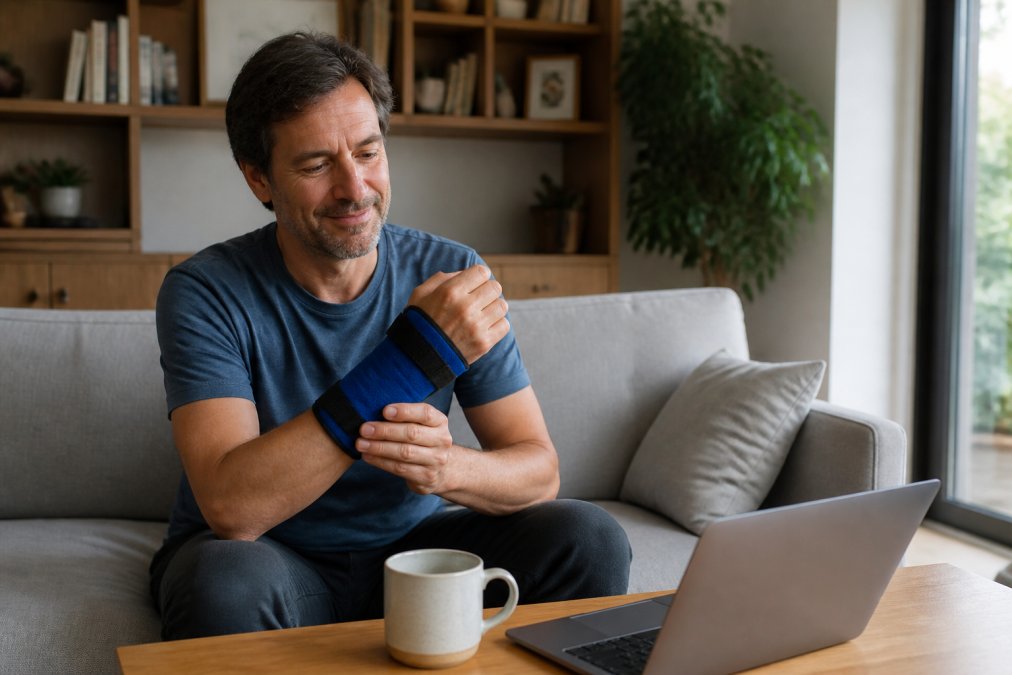
Step 1: Rest and Activity Modification
Cut back on the movement that caused the problem. If typing flares your wrist, take shorter sessions and more breaks; if climbing flares your fingers, skip crimpy routes for a week or two.
Step 2: Cold Compression Therapy
Apply cold therapy for 15 to 20 minutes at a time, several times a day. A cold compression sleeve makes this easier because it stays put and adds gentle pressure.
Step 3: Elevation and Compression
Prop the sore joint above heart level when you can, for a wrist or elbow, rest it on a pillow while sitting or lying down. Compression from a fitted sleeve supports this and helps reduce swelling.
How Long Does Tendonitis Take to Heal?
Most mild cases improve within two to four weeks with consistent home care. Stubborn or chronic cases from years of repetitive strain can take six to twelve weeks or longer, and a small share, often in the wrist, elbow, or Achilles, linger past three months and behave more like degenerative tendinopathy than a fresh inflammatory flare.
A Week-by-Week Recovery Roadmap
Tendonitis follows a fairly predictable arc when you actually rest the tendon instead of pushing through. Here is what a typical home recovery looks like, phase by phase.
| Phase | Timeframe | What You Should Feel | What to Do | Red Flag |
|---|---|---|---|---|
| Acute | Days 1-3 | Sharp, localized pain; swelling or heat at the site | Rest, cold compression 15-20 minutes several times a day, elevate above heart level | Pain getting worse each day instead of better |
| Early healing | Week 1-2 | Pain drops from sharp to a dull ache; stiffness in the morning | Gentle range of motion, activity modification, continue cold after flare-ups | No improvement at all by day 10 |
| Rebuilding | Week 3-6 | Pain mostly gone at rest; mild soreness with use | Light stretching, isometric holds, gradual strength work | Pain returns to acute levels after light activity |
| Return | Week 6+ | Minimal to no pain during normal activity | Full activity, ergonomics, prevention habits | Pain that never fully resolves or keeps returning |
What Each Phase Actually Looks Like
Days 1-3 (acute). The tendon is inflamed and reactive, and your only job is to calm it down. Cold compression sleeves make this easier because you can wear one at a desk or on the couch instead of holding an ice pack. Keep sessions to 15-20 minutes, three to four times a day.
Penguin Fingers Elbow and Foot Cold →

When Recovery Stalls
If you are past week three and pain is not trending down, something needs to change. The most common culprits: you never actually rested the tendon, you are still doing the movement that caused the problem even at lower volume, or the tendon needs more than home care, physical therapy, eccentric loading, or a medical evaluation.
Best Cold Compression Sleeves for Tendonitis
The best cold compression sleeve for tendonitis fits the specific joint, stays cold long enough, and adds even compression, three things a generic ice pack cannot do.
| Product | Best For | Price |
|---|---|---|
| Finger and Toe Gel Pack Sleeve | Fingers, toes, trigger finger | $14.95 |
| Wrist Cold Compression Pack | Wrist pain, carpal tunnel, typing strain | $16.95 |
| Elbow and Foot Cold Compression Sleeve | Elbows, ankles, feet, forearms | $22.95 |
| Knee Cold Compression Sleeve | Knees, thighs, calves | $28.95 |
Preventing Flare-Ups: Ergonomics for Desk Workers and Athletes
Preventing a flare-up comes down to better ergonomics and smarter training loads. Small changes to how you sit, type, and train keep a tendon from getting irritated again, and for remote workers, the setup matters more than most guides admit. A kitchen table and a laptop is a tendonitis recipe for the wrists, elbows, and shoulders.
Home Office Setup for Remote Workers
If you spend six or more hours a day at a laptop, your wrists, forearms, and shoulders carry constant low-grade load, the exact pattern behind wrist tendonitis, tennis elbow, and rotator cuff irritation. A few adjustments make a measurable difference:
- Get the screen to eye level. A laptop on a desk forces your neck down and your shoulders forward. A stack of books or a laptop stand fixes this for free. Pair it with an external keyboard and mouse so your hands can rest lower.
- Keep wrists neutral. Your wrist should be flat, not bent up (extension) or down (flexion). A wrist rest or a negative-tilt keyboard tray helps. If your keyboard has fold-out feet, fold them in, a flat or slightly negative slope keeps the wrist straighter.
- Set elbows near 90 degrees. Adjust your chair height so your forearms are roughly parallel to the floor. If your elbows are below your wrists, you are loading the forearm tendons all day.
- Support the forearms. Armrests or a desk edge that lets your forearms rest takes load off the elbows and shoulders. Floating arms are a common cause of tennis elbow in desk workers.
- Take a 60-second break every 30 minutes. Stand up, roll your shoulders, open and close your hands, and shake out your wrists. Micro-breaks beat one long break at lunch.
- Switch input devices if you can. A vertical mouse or a trackball changes the wrist angle and can calm a flare. Alternate hands for mouse work if you are able.
- Watch the phone and tablet. Holding a phone for long stretches loads the thumb tendons. Use a stand or speaker when you can.
A Simple Daily Routine for Desk-Bound Wrists and Shoulders
A short routine, done once or twice a day, keeps the tendons from tightening up:
- Wrist flexor and extensor stretch. Extend one arm, palm up, and gently pull the fingers back with the other hand. Hold 20-30 seconds. Flip the palm down and repeat.
- Shoulder rolls. Ten slow rolls forward, ten back. This wakes up the rotator cuff and upper back.
- Doorway chest stretch. Place forearms on a doorframe, step through gently, and hold 20-30 seconds. This counteracts the rounded-shoulder posture that comes with laptop work.
- Grip release. Squeeze a soft ball for five seconds, then open the hand wide. Repeat ten times per hand.
For Athletes and Climbers
Training load is the other half of prevention. Tendons adapt more slowly than muscles, so a jump in volume or intensity is the classic trigger for a flare.
- Warm up before intense sessions, five to ten minutes of easy movement gets blood flowing to the tendon
- Build load gradually, not in jumps. A rough rule of thumb is to increase weekly volume by no more than about 10 percent
- Cool down and stretch after training, focusing on the tendons you just loaded
- Use cold compression after hard sessions to calm inflammation before it builds
- Take at least one full rest day per week from the activity that stresses the tendon
The Long Game
Ergonomics is not a one-time fix but an ongoing habit. People who avoid repeat flares check their setup and training load every few weeks rather than fixing it once and forgetting it.
When to See a Doctor (and What Not to Do)
See a doctor if pain lasts more than a few weeks, gets worse, or comes with numbness, weakness, or a joint that will not move, signs of something beyond simple tendon irritation.
Frequently Asked Questions
What is the fastest way to get rid of tendonitis?
The fastest way to treat tendonitis at home is to start the RICE method immediately: rest the affected area, apply cold compression for 15-20 minutes several times a day, use a compression bandage, and elevate the joint. Cold compression sleeves can deliver simultaneous cooling and compression, which may speed up recovery. Over-the-counter NSAIDs can help with acute pain, but they don't heal the tendon. Most mild cases improve within 2-4 weeks with consistent home care.
What are the four symptoms of tendonitis?
The four main symptoms of tendonitis are pain at the tendon site, swelling, stiffness, and loss of range of motion. You may also notice a dull ache that worsens with movement or a tender bump near the joint. These signs indicate inflammation in the tendon sheath. If symptoms persist beyond a few weeks, see a doctor to rule out other conditions like tendinopathy or a tear.
What not to do with tendonitis?
Avoid ignoring the pain and pushing through activities that caused the injury. Don't apply heat during the first 48 hours, as it can increase swelling. Skip aggressive stretching or massage while the tendon is acutely inflamed. Don't rely solely on painkillers to mask symptoms and continue the same repetitive strain. Also, avoid complete immobilization for too long, which can weaken the tendon. Gentle range-of-motion exercises are better once acute pain subsides.
Can you treat tendonitis with cold compression therapy?
Yes, cold compression therapy is one of the most effective home treatments for tendonitis. Cold reduces inflammation and numbs acute pain, while compression minimizes swelling and provides joint support. Wearable cold compression sleeves, like those from Penguin Fingers, offer targeted relief for fingers, wrists, elbows, and other joints. Use them for 15-20 minutes every 2-3 hours during the first few days, then as needed for pain management.


