

Table of Contents
- Why Climbers Need Wrist Support
- How to Tape Wrists for Climbing
- Choosing the Best Wrist Wrap for Climbing
- TFCC Tear Climbing Recovery: What to Expect
- Wrist Pain Prevention for Rock Climbers
- Brace vs. Wrap vs. Rest: When to Use Each
- Frequently Asked Questions
Last Updated: September 23, 2026
Why Climbers Need Wrist Support
Wrist support for climbing is a wrap, brace, or taping method that limits excessive wrist movement while preserving grip. This guide from Penguin Fingers covers ulnar-side wrist pain, taping, and how to choose the best wrist wrap for climbing.

TFCC Injuries and Ulnar-Side Wrist Pain
TFCC injuries develop from repetitive loading in wrist extension and rotation, especially on crimps and underclings. Symptoms include a dull ache on the pinky side, pain with rotation, and clicking or catching. Druj instability, when the distal radioulnar joint becomes unstable from TFCC damage, is a serious progression. Stabilizing the joint through proper support remains a cornerstone of managing sports injuries that threaten long-term climbing performance.
Signs to watch for:
- Pain when turning a doorknob or wrenching open a jar
- Aching that worsens after sloper-heavy sessions
- Weakness in the pinky-side grip
- Clicking or grinding with rotation
How to Tape Wrists for Climbing
Taping uses rigid or semi-rigid tape to restrict wrist hyperextension and support the ulnar side without locking the joint. A common protocol takes about two minutes with 1.5-inch athletic tape.
Here's a practical sequence:
- Clean and dry the wrist. Tape doesn't stick to chalk or sweat.
- Apply a thin underwrap if you have sensitive skin.
- Anchor a strip around the base of the hand, just below the knuckles.
- Run a strip diagonally across the back of the wrist toward the ulnar side.
- Run a second strip across the palm side, slightly offset.
- Add a figure-eight wrap around the wrist for rotation support.
- Test the wrap by making a fist and rotating your wrist. It should feel supported, not stiff.
Choosing the Best Wrist Wrap for Climbing
The best wrist wrap for climbing offers adjustable tension, breathable material, and a low-profile fit that doesn't interfere with your grip, chalk bag, or belay device. Fit matters more than brand, test how it behaves after 90 minutes of sweating.
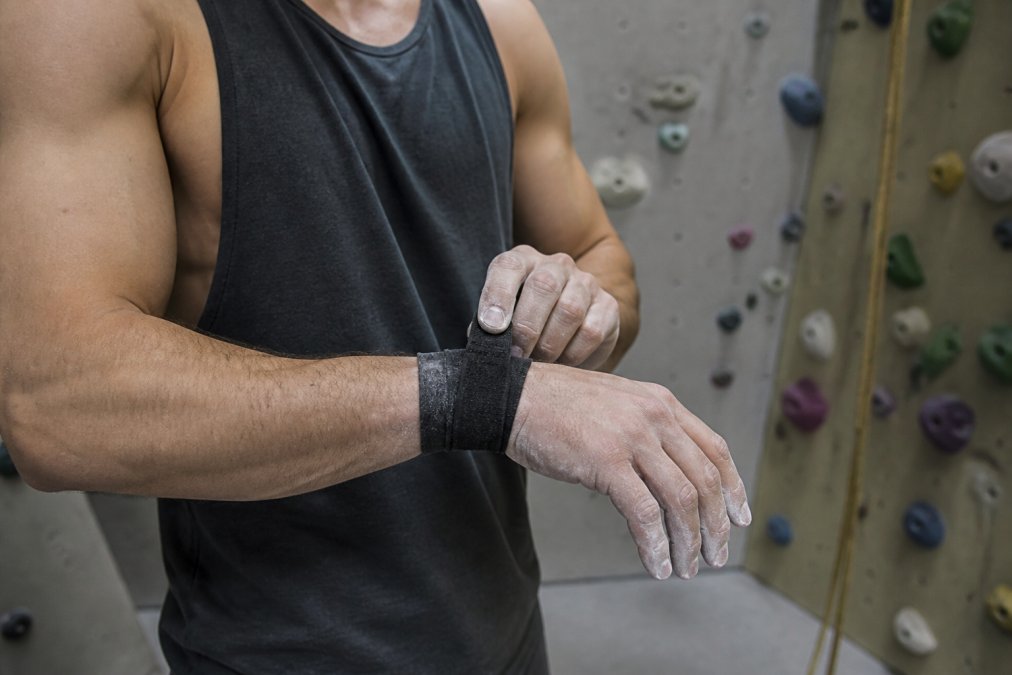
Look for these features:
| Feature | Why It Matters | What to Avoid |
|---|---|---|
| Adjustable tension | Lets you dial support up or down mid-session | Fixed-size sleeves |
| Breathable fabric | Reduces sweat buildup and skin irritation | Non-breathable neoprene |
| Low-profile design | Fits under a chalk bag strap and doesn't snag | Bulky orthopedic braces |
| Moisture-wicking liner | Keeps grip dry and prevents slipping | Cotton-only liners |
| Ulnar-side support | Targets the TFCC region specifically | Generic wrist wraps |
| Hook-and-loop closure | Re-tensionable with chalky fingers | Buckles or laces that clog with chalk |
Adjustable Tension and Range of Motion
Adjustable tension lets you tune support to the climb, an overhang bouldering session needs more compression than a slab problem. Hook-and-loop closures give you that control and resist chalk better than laces or buckles.
Breathability and Sweat Management
Breathable fabric and moisture-wicking liners keep the wrist dry. Wet skin under a wrap loses grip strength because the wrap slips, and it macerates the skin. Neoprene traps sweat, so look for perforated or mesh-backed materials. Field test: wear it for a 20-minute warm-up, then check the underside, if the liner is damp and the wrap has rotated, it will fail on a long pitch.
Gear Compatibility: Chalk Bags, Harnesses, and Belay Devices
Most reviews ignore how a wrap interacts with your kit. A wrap that sits high catches under a chalk bag strap; one that extends too far down the forearm rubs a harness waist belt or interferes with feeding rope through a belay device.
Practical checks before you commit to a wrap:
- Wear it with your chalk bag on and reach into the bag ten times. If the strap catches the wrap edge, the wrap is too tall.
- Put on your harness and hang on a jug. If the waist belt presses the wrap into your hip bone, the wrap extends too far down the forearm.
- Clip in and feed rope through your belay device. If the wrap restricts the wrist rotation you need to pay out slack smoothly, it's too stiff for belaying.
- Try it under a long-sleeve layer if you climb in cool conditions. Bulky wraps bunch fabric at the wrist and create pressure points.
Bouldering vs. Sport Climbing: Different Wraps for Different Loads
Bouldering and sport climbing load the wrist differently, so the wrap that works for one may be wrong for the other.
Long-Term Dependency: When Support Becomes a Crutch
Wrapping every session carries a real cost. Wrist stabilizers, flexors, extensors, and pronators, adapt to load, so if a wrap consistently does the work, those muscles weaken over months. The wrist then feels fine while wrapped and fragile when it isn't.
- Wear a wrap during flare-ups, high-volume sessions, and projecting on hard terrain.
- Take it off for warm-ups, easy mileage, and technique drills so the wrist still gets loaded.
- Strengthen wrist flexors, extensors, and pronators twice a week with dedicated work, light dumbbells, rice bucket, or a wrist roller.
- Reassess every few weeks. If you no longer need the wrap on moderate terrain, leave it in the bag.
TFCC Tear Climbing Recovery: What to Expect
TFCC tear climbing recovery typically takes 6-12 weeks for minor tears with conservative treatment, and longer for full tears or post-surgical cases, depending on tear grade, rest, and how quickly you start guided rehab.
Recovery stages:
- Weeks 1-2: Rest, immobilization, and ice to reduce acute inflammation
- Weeks 3-6: Gentle range-of-motion work and isometric strengthening
- Weeks 6-12: Progressive loading, grip work, and light climbing on easy terrain
- Months 3-6: Return to full climbing with ongoing strengthening
Wrist Pain Prevention for Rock Climbers
Wrist pain prevention for rock climbers comes down to load management, strengthening, and honest self-assessment. Most wrist injuries aren't caused by one bad move, they build up over weeks of repetitive stress.
Prevention checklist:
- Warm up with easy traverses for 10 minutes before projecting
- Strengthen wrist flexors, extensors, and pronators twice a week
- Vary grip types instead of crimping every session
- Stop when you feel ulnar-side ache, not when you can't hold on
- Use a wrap or tape during high-volume sessions, not every session
- Take a deload week every 4-6 weeks
Brace vs. Wrap vs. Rest: When to Use Each
Use a wrap for support during activity, a brace for immobilization after injury, and rest for acute pain, swelling, or loss of motion. Choosing the wrong one delays recovery.
| Option | Best For | When to Avoid |
|---|---|---|
| Wrap | Mild pain, prevention, high-volume sessions | Acute injury, swelling |
| Brace | Post-injury immobilization, doctor-directed | Long-term climbing use |
| Rest | Acute pain, swelling, clicking, weakness | Mild soreness only |
A Decision Framework You Can Actually Use
Here's how to apply the table above:
Acute pain, swelling, or loss of motion: rest and see a clinician. A wrap or brace won't fix an acute injury, and climbing on it makes it worse.
How Bouldering and Sport Climbing Change the Decision
The right choice between wrap, brace, and rest depends on the discipline, because the failure modes differ.
The Dependency Trap: Why More Support Isn't Better
The most common mistake is treating a wrap as a permanent upgrade. It isn't. Wrist stabilizers, flexors, extensors, and pronators, respond to load like any other muscle. If a wrap consistently absorbs the load, those muscles get less stimulus and weaken over months. The wrist then feels fine while wrapped and fragile when it isn't.
The fix is a taper, not abstinence:
- Acute phase: full support, reduced climbing volume, focus on pain-free range of motion.
- Return phase: wrap on harder terrain, no wrap on easy terrain, dedicated strengthening twice a week.
- Maintenance phase: wrap only for projecting or high-volume weeks, no wrap for mileage, strengthening stays in the plan.
Frequently Asked Questions
Can I still climb with a TFCC tear?
Many climbers continue climbing with a TFCC tear, but with modifications. A wrist wrap or brace can provide joint support and limit painful range of motion. Focus on open-hand grips rather than crimps, reduce training volume, and avoid dynos that stress the wrist. Consult a healthcare provider for diagnosis, as TFCC injuries range from mild sprains to full tears requiring immobilization.
What is the difference between a wrist wrap and a wrist brace for climbing?
A wrist wrap typically uses elastic material to apply adjustable compression and is less restrictive, making it popular for climbing where feel matters. A wrist brace often includes rigid supports or splints that limit movement more firmly. For climbing, a low-profile wrap or compression sleeve usually works better because it preserves grip and range of motion while still offering joint support.
Are compression sleeves effective for climbing-related wrist pain?
Compression sleeves can help with mild wrist pain by improving proprioception and reducing swelling. They work well for tendonitis and repetitive stress, but they are less effective for structural injuries like TFCC tears where more stabilization is needed. Pairing a compression sleeve with cold compression therapy after sessions can support recovery time and manage inflammation.
How do I choose the right size wrist support for climbing?
Measure your wrist circumference at the narrowest point, usually just below the wrist bone. Most brands provide sizing charts based on this measurement. A proper fit should feel snug but not restrict circulation or pinch when you make a fist. Adjustable wraps offer more flexibility if you are between sizes or want to change tension during a session.
Wrist pain doesn't have to end your climbing season. The right wrap, honest load management, and consistent recovery habits keep you on the wall longer. Penguin Fingers makes targeted cold compression therapy sleeves and wraps designed for sore, swollen joints, with wearable designs for wrists and dual hot and cold therapy options that support both acute recovery and ongoing relief. Get started with Penguin Fingers and give your wrists the support they need to keep climbing.


