

Table of Contents
- What Runner's Knee Is and Where It Hurts
- Why Your Knee Hurts Running but Not Walking
- Immediate Steps to Settle Soreness and Swelling
- Knee Strengthening Exercises at Home
- Runner's Knee Stretches and Mobility Work
- How to Prevent Knee Pain While Running
- Return-to-Running Plan and When to See a Doctor
- Get Back to Running with the Right Recovery Support
- Frequently Asked Questions
Last Updated: November 20, 2026
What Runner's Knee Is and Where It Hurts
Runner's knee is pain around or behind the kneecap that shows up during or after running. Doctors call it patellofemoral pain, and it is one of the most common running complaints. The ache usually sits at the front of the knee, right where the kneecap tracks against the thigh bone.
Runners often describe a dull burn under the kneecap on stairs, hills, or long runs. The pain is often vague. You can't point to one spot.
Here is where it tends to show up:
- Front of the knee, around the kneecap
- Behind the kneecap, worse going downhill
- Inner edge of the kneecap, tender to touch
- A grinding or clicking feeling with deep knee bends
The pain comes and goes. That pattern matters, and it is the first clue in learning how to manage knee pain while running.
Why Your Knee Hurts Running but Not Walking
Running loads the knee at up to several times your body weight with every stride. Walking loads it far less. That gap explains the strange pattern: your knee feels fine all day, then hurts after two miles.
The kneecap is a tracking problem, not a wear problem. Weak hip muscles let the thigh rotate inward. The kneecap then pulls sideways instead of gliding straight. Running repeats that bad path thousands of times per session.
Downhill sections make it worse. The knee absorbs more force as you descend, which is why many runners feel pain on descents and not on flat ground. Why knee pain hits after downhill hiking comes down to the same mechanics. why downhill hiking loads the knee so heavily comes down to the same mechanics.
So if walking is fine and running is not, your knee is telling you about load and control, not about damage.
Immediate Steps to Settle Soreness and Swelling
Stop the run early when pain changes your stride. That single rule prevents most flare-ups from getting worse.
Then work through these steps:
- Cut the distance and pace for 5 to 7 days. Keep moving, but shorter.
- Apply cold to the sore area for 15 to 20 minutes at a time.
- Elevate the leg above heart level when you can.
- Try over-the-counter pain relief if needed, and follow the label.
- Skip deep knee bends and stairs while it is angry.
Cold therapy is the workhorse here. A wearable knee sleeve stays in place while you move, which beats balancing a loose ice bag. You can browse our wearable knee cold compression sleeve for a wrap that stays put on the joint.
Watch out: never put ice directly on bare skin, and never leave a cold pack on for more than 20 minutes.
For a full routine, our guide to treating sore joints after exercise walks through each step in order. If you want the timing details first, read how long to ice a sports injury before you start.
Knee Strengthening Exercises at Home
The best home program trains the hip and the knee together.
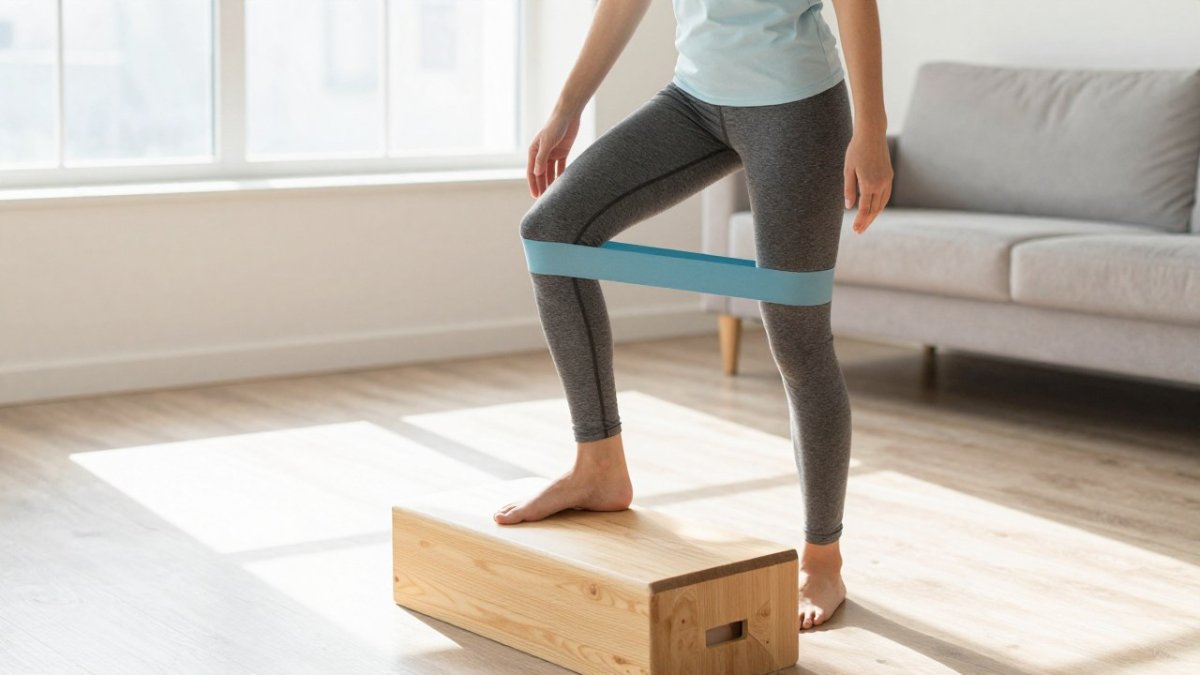
Try this three-move set, three times per week:
- Step-ups: 3 sets of 10 per leg on a low step
- Glute bridges: 3 sets of 12, squeeze at the top
- Wall sits: 3 holds of 20 to 30 seconds
Keep the knee lined up over the middle toes. A common mistake is pushing through sharp pain to "strengthen it." Strength work should feel like effort, not a stab.
These knee strengthening exercises at home need no gym and no equipment beyond a step.
Runner's Knee Stretches and Mobility Work
Tight quads and hip flexors pull the kneecap off its track. Stretching will not fix weakness, but it makes the strengthening work land better.
Add these after runs, when muscles are warm:
- Standing quad stretch: 30 seconds per side
- Hip flexor lunge stretch: 30 seconds per side
- Calf stretch against a wall: 30 seconds per side
- Foam rolling the outer thigh and glutes: 60 seconds per area
Keep stretches gentle. Bouncing or forcing a stretch irritates the joint. A case study of a runner with outer knee pain used a mix of therapeutic exercise, manual therapy, and plyometric work, which shows how varied rehab can be (University of North Dakota case study).
How to Prevent Knee Pain While Running
Prevention comes down to load management. As the knee adapts to each change in training load, runner's knee stretches and recovery can support a gradual return to running.
Training-load adjustments you can apply this week:
- Distance: Raise weekly distance by no more than about 10%, and hold that new level for two weeks before raising it again. If you currently run 20 miles a week, the next step is about 22, not 26.
- Intensity: Keep hard efforts to no more than two sessions a week, and never pair a new distance high with a new speed session in the same week.
- Hills: Add hills one run at a time. On descents, shorten your stride and let your cadence rise rather than braking with a long stride, which loads the kneecap hardest.
- Frequency: Splitting the same weekly distance across more runs lowers the load per session. Four 5-mile runs stress the knee less than two 10-mile runs.
- Surfaces: Run on even surfaces when symptoms are fresh. Cambered roads and uneven trails ask more of the knee's tracking control.
Cross-training that keeps fitness without pounding the joint:
- Cycling: 30 to 45 minutes at an easy effort replaces a recovery run and keeps the quads and hips working without impact.
- Swimming or pool running: Best for a flare-up week when you want to keep aerobic fitness while the knee calms down.
- Elliptical: A middle option that adds some weight-bearing load without the repeated impact of running.
A common pattern is to replace every missed run with a hard cross-training session. Keep cross-training easy on the days you would have run easy, or you simply move the overload to a different machine.
Habits that support the plan:
- Keep one easy week after every two harder ones.
- Rotate shoes and replace worn pairs; a midsole that has lost its bounce passes more force up the leg.
- Warm up with five minutes of easy jogging before any faster work.
To learn how to prevent knee pain while running long term, watch your cadence. A slightly quicker, shorter stride lowers the load on the kneecap (pubmed.ncbi.nlm.nih.gov).
Watch out: if pain returns every time you reach the same weekly distance, the problem is not the plan's pace but the ceiling itself. Hold below that distance for two to three weeks while you build hip and quad strength, then try again.
Return-to-Running Plan and When to See a Doctor
Return to running in stages, and let pain be the guide. A simple rule: pain during a run should stay at 3 out of 10 or lower, and settle within 24 hours. But that rule only works if you check three time points, not one.
The three-check framework:
- During the run: Does pain change your stride? If you are limping or altering your gait to avoid the ache, stop and walk. If pain stays at 3/10 or below and your stride looks normal, you can finish the planned segment.
- After the run: Does soreness settle within a couple of hours of stopping, or does it linger into the evening? Lingering soreness is a signal to hold the current stage rather than progress.
- The next morning: Is the knee back to its baseline, or is it stiffer and more painful than before the run? A next-day flare means you advanced too fast; drop back one stage for a week.
Use those three checks to move through this staged plan:
| Stage | What You Do | Progress Criteria |
|---|---|---|
| 1 | Walk-jog intervals, 10 minutes total | No pain above 3/10 during, after, or next morning |
| 2 | Easy continuous run, 15 minutes | Symptoms settle within 24 hours for two consecutive runs |
| 3 | Add 5 minutes per run, every third run | No next-day flare across a full week |
| 4 | Reintroduce hills, descend slowly | Knee stays quiet on descents and the following day |
| 5 | Return to normal distance | Hold two weeks at full distance before adding speed work |
A common pattern is to feel good at stage 3 and jump straight to normal mileage. That jump is what sends most runners back to stage 1. Hold each stage for at least a week, and only advance when all three checks pass.
Differentiating runner's knee from other knee pain. Patellofemoral pain is not the only cause of a sore knee. A concise location guide helps you know what you are dealing with:
- Front, around or behind the kneecap: most consistent with runner's knee; worse on stairs, hills, and deep bends.
- Outer knee, near the joint line: often iliotibial band irritation; pain typically sharpens on longer runs and eases when you stop.
- Inner knee, below the joint line: can point to a meniscus issue, especially with twisting or a catching sensation.
- Upper shin, below the kneecap: can be patellar tendon irritation, which usually hurts most at the start of a run and warms up.
This guide is for orientation, not diagnosis. If the location does not match runner's knee, treat the pain as a reason to get assessed rather than to push through the same plan.
When to see a doctor. Distinguish routine assessment from urgent care:
- Urgent: major swelling within hours of an injury, inability to bear weight, a knee that locks or gives way, or a knee that is hot, red, and accompanied by fever. Seek care promptly.
- Routine: pain at rest, pain that worsens after two weeks of load changes, swelling that will not go down, or pain that keeps returning at the same stage. Book an evaluation with a clinician or physical therapist.
A runner-specific timeline helps here, and our guide on ankle sprain recovery for runners shows how week-by-week progress should look.
Get Back to Running with the Right Recovery Support
Recovery support makes the difference between a two-week setback and a two-month one. Cold compression right after a run calms the joint, and consistent strength work keeps the kneecap tracking straight.
Penguin Fingers makes wearable cold compression sleeves designed for joint recovery. Penguin Fingers offers wearable cold compression sleeves designed for specific body parts, with dual hot and cold therapy options.
Visit the Penguin Fingers website for current products and pricing to support your recovery.
Your knee has been telling you something for weeks. The fix is not rest forever, and it is not pushing through. It is load control, strength, and cold therapy done consistently. That is the whole plan, and it works.
Frequently Asked Questions
Should I keep running if my knee hurts?
It depends on the pain level and pattern. Mild soreness that eases within a day or two of lighter running may be safe to work through with load adjustments. Sharp pain, swelling, or pain that worsens as you run calls for a break. If pain persists beyond two weeks or returns every time you run, get a medical assessment before continuing.
Why does my knee hurt when I run but not when I walk?
Running increases the load on the kneecap and surrounding tissues far more than walking because of higher impact forces and a greater knee bend. Weak hip and glute muscles can let the knee drift inward during running, concentrating stress on the kneecap. That is why knee pain running but not walking is a common pattern, and why strengthening the hips matters as much as the knee.
How long should I rest from running with knee pain?
Most mild runner's knee flare-ups settle with 3 to 7 days of reduced load, not complete bed rest. Swap runs for low-impact cross-training like cycling or swimming to keep fitness while the knee calms. Use the pain-monitoring rule: discomfort should be no more than 3 out of 10 during activity and settle within 24 hours. If pain has not improved after two weeks of modified training, or if swelling or locking appears, see a doctor or physical therapist for an assessment.
What exercises help prevent knee pain in runners?
At home, try glute bridges, side-lying leg lifts, step-ups, and wall sits to build hip and quadriceps strength. Add controlled single-leg balances to improve stability. Pair these with foam rolling for the quadriceps and calves, and progress gradually. Consistency two to three times per week beats occasional long sessions, and stronger muscles help absorb running load before it reaches the kneecap.


