

Table of Contents
- Why Your Joints Feel Stiff When You Wake Up
- Best Morning Stretches for Arthritis and Joint Mobility
- Cold Compression Therapy for Joint Pain Relief
- Heat Therapy and Warm Showers to Ease Morning Stiffness
- How to Reduce Joint Inflammation Naturally Through Hydration and Diet
- Sleep Hygiene and Mattress Selection for Joint Health
- Build Your Morning Routine to Combat Stiffness
- Assistive Devices and Tools for Morning Mobility
Last Updated: August 23, 2026
Why Your Joints Feel Stiff When You Wake Up
Morning joint stiffness occurs because your joints don't move for 6-8 hours during sleep. Without movement, synovial fluid, the lubricant that keeps joints moving smoothly, doesn't circulate efficiently (peer-reviewed research). Your body's circadian rhythm also plays a role: inflammatory markers peak in early morning hours, making stiffness and pain feel worse right after waking (peer-reviewed research). Additionally, muscles cool and tighten overnight, and for people with arthritis, the extended rest period allows inflammation to settle, making joints feel particularly stiff until movement and warmth restore mobility.
Best Morning Stretches for Arthritis and Joint Mobility
The best morning stretches focus on gentle, low-impact movements that gradually increase range of motion without forcing your joints. These stretches activate synovial fluid circulation and warm muscles that have been inactive overnight. You can perform most stretches while still in bed, reducing stress on your joints and making the routine more sustainable.
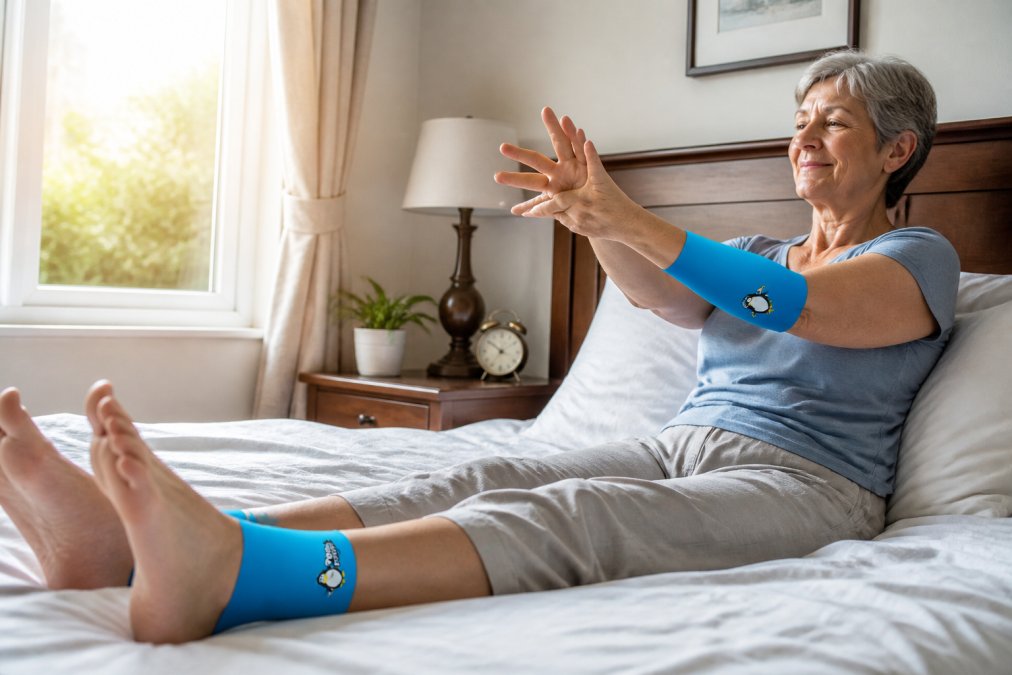
In-Bed Ankle Pumps and Wrist Circles
Ankle pumps: While lying in bed, point your toes downward as far as comfortable, then flex them back toward your shins. Repeat 20-30 times slowly. This pumping action activates the calf muscles and encourages synovial fluid to move through your ankle joints.
Wrist circles: Extend your arms in front of you or rest them on the bed. Slowly rotate your wrists in small circles, 10 rotations in each direction with both hands simultaneously. Wrist circles are particularly valuable if you spend your day typing, as they address joints that accumulate tension.
Both movements should feel easy and pain-free. If you experience sharp pain, stop and try more gently.
Gentle Range-of-Motion Exercises
Once you've completed ankle pumps and wrist circles, progress to exercises involving larger joints.
Knee lifts: While lying on your back, slowly lift one knee toward your chest, then lower it. Repeat 10 times on each leg.
Hip circles: Bend one knee and place that foot flat on the bed. Slowly rotate your knee in circles, moving it inward and outward.
Shoulder rolls: Slowly roll your shoulders backward 10 times, then forward 10 times.
Gentle spinal twists: While seated in bed, place your right hand behind your head and slowly rotate your torso to the right, looking over your shoulder. Hold for 5-10 seconds, then repeat on the left side. Perform 5 repetitions on each side.
The entire routine should take 5-10 minutes. Consistency is key, perform these stretches every morning to prevent stiffness from returning and build long-term mobility improvements.
Cold Compression Therapy for Joint Pain Relief
Cold compression therapy reduces joint inflammation and pain by constricting blood vessels in the affected area, reducing swelling and numbing pain signals (peer-reviewed research). Compression stabilizes the joint and reduces fluid buildup that contributes to stiffness.
For managing morning joint stiffness, apply cold compression after you've completed your gentle stretching routine and your joints have warmed up slightly. Applying cold immediately upon waking can actually increase stiffness temporarily.
The Penguin Fingers Cold Compression Gel Packs for Fingers and Toes ($14.95) are specifically designed for small joints most affected by morning stiffness. These packs conform to your fingers and toes, delivering targeted cold and compression without bulk. For larger joints like wrists, elbows, and knees, the Penguin Fingers Wrist Cold Compression Pack ($16.95) and Penguin Fingers Elbow and Foot Cold Compression Therapy Sleeve ($22.95) offer targeted relief. The key advantage is that these wearable solutions stay in place while you move around your home.

Cold therapy is most effective when applied for 15-20 minutes at a time, several times throughout the day.
Heat Therapy and Warm Showers to Ease Morning Stiffness
Heat therapy increases blood flow to affected joints, relaxes muscles, and makes synovial fluid more effective at lubricating joints. For many people, heat is the more effective first intervention because it addresses sluggish joint lubrication and muscle tightness.
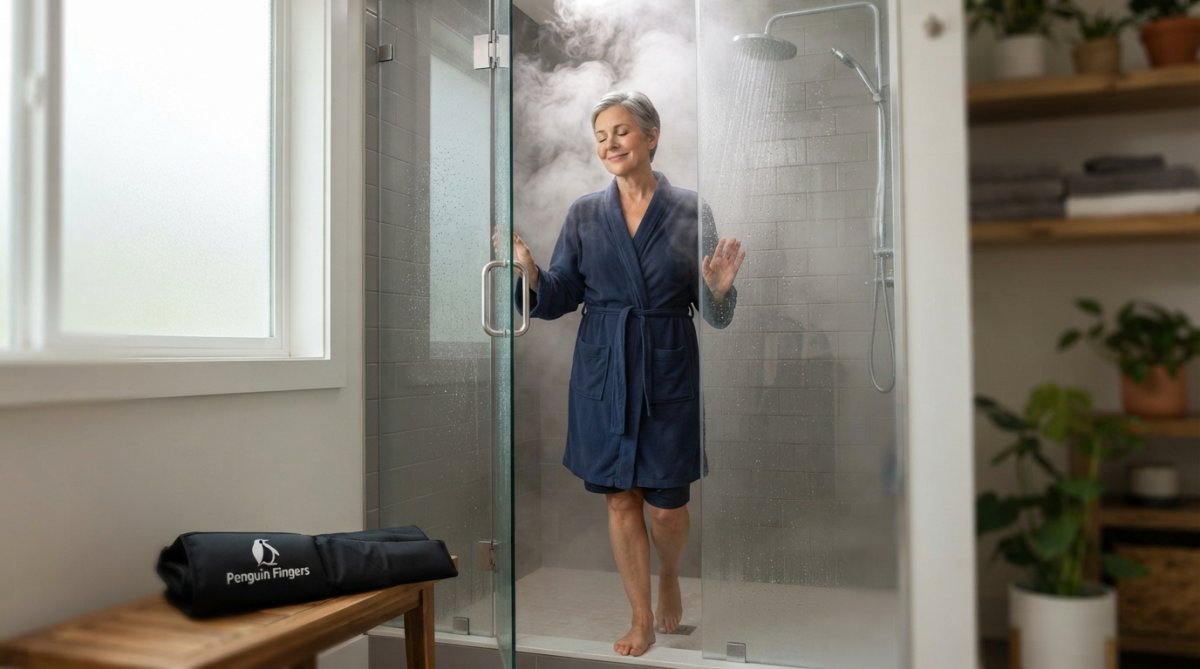
A warm shower immediately after waking is one of the simplest and most effective ways to reduce morning stiffness. Spend 5-10 minutes under warm water, directing it toward areas where you experience the most stiffness, hands, wrists, knees, and lower back are common problem areas. The combination of heat and gentle movement works synergistically to restore mobility.
For targeted heat therapy beyond the shower, heating pads applied for 15-20 minutes or warm baths are effective options. Electric blankets or heated mattress pads can help by keeping your joints warm throughout the night, reducing morning stiffness severity before it starts.
The Penguin Fingers Elbow and Foot Cold Compression Therapy Sleeve and Penguin Fingers Knee Cold Compression Therapy Sleeve ($28.95) offer dual hot and cold therapy options, allowing you to apply heat in the morning and cold later in the day depending on your needs. Many people find that alternating between heat and cold, starting with heat to restore mobility, then using cold mid-day if inflammation returns, provides the most comprehensive relief.
How to Reduce Joint Inflammation Naturally Through Hydration and Diet
Joint inflammation drives morning stiffness. While stretching and temperature therapy address symptoms, hydration and diet address the underlying inflammatory state. Your joints depend on adequate hydration to produce and maintain synovial fluid. When dehydrated, this lubricating fluid becomes thicker and less effective, exacerbating stiffness. improving your posture.
Drinking 8-10 glasses of water daily can meaningfully reduce morning joint stiffness. Benefits are cumulative; consistent hydration over weeks typically results in noticeably reduced stiffness.
Anti-inflammatory foods also play a significant role. Foods rich in omega-3 fatty acids, salmon, mackerel, walnuts, and flaxseeds, have natural anti-inflammatory properties. Fruits and vegetables high in antioxidants, particularly berries, leafy greens, and colorful vegetables, help reduce systemic inflammation. Ginger and turmeric contain compounds with documented anti-inflammatory effects.
Minimize processed foods, refined carbohydrates, and foods high in omega-6 fatty acids, which can increase inflammatory markers. A consistent pattern of adequate hydration and anti-inflammatory eating reduces morning stiffness over time, with noticeable improvements typically appearing within 2-4 weeks.
Sleep Hygiene and Mattress Selection for Joint Health
Your sleep environment directly impacts morning joint stiffness. Poor sleep position, inadequate mattress support, and a cold bedroom all contribute to increased stiffness upon waking.
Mattress selection is crucial. A mattress that's too soft allows your spine and joints to sink into misalignment. A mattress that's too firm creates pressure points that restrict blood flow. The ideal mattress provides balanced support, firm enough to maintain proper spinal alignment, but cushioned enough to distribute pressure evenly. If your current mattress is more than 8-10 years old, it likely contributes to morning stiffness.
Sleep position matters equally. Sleeping on your back with a pillow supporting your neck and a pillow under your knees maintains neutral spinal alignment and prevents joint compression. Side sleepers should use a pillow between their knees to prevent hip and spine misalignment. Avoid sleeping on your stomach, which forces your neck into rotation.
Room temperature affects joint stiffness. A cold bedroom (below 65°F) causes muscles to contract and tighten. Keeping your bedroom at 68-72°F is ideal. An electric blanket or heated mattress pad can maintain warmth without restricting movement.
Consistency in sleep schedule also reduces morning stiffness. Going to bed and waking at the same time daily helps regulate your circadian rhythm and can reduce inflammatory peaks that occur in early morning hours.
Build Your Morning Routine to Combat Stiffness
Creating a structured morning routine specifically designed to manage morning joint stiffness is the most effective long-term strategy. Follow this logical progression: gentle in-bed stretching, heat therapy, more active stretching, and then cold compression if needed.
Here's a practical morning routine that takes 30-45 minutes total:
-
Upon waking (5 minutes): Perform ankle pumps and wrist circles while still in bed. Drink a glass of water.
-
Warm shower (10 minutes): Direct warm water toward stiff joints. Perform gentle stretching movements under the water.
-
In-bed range-of-motion exercises (5 minutes): Complete knee lifts, hip circles, shoulder rolls, and gentle spinal twists.
-
Light activity (10 minutes): Get out of bed and perform light activity like walking slowly around your home or doing gentle household tasks.
-
Cold compression if needed (15-20 minutes): If inflammation or pain remains, apply cold compression therapy to affected joints.

Penguin Fingers Elbow and Foot Cold Compression Therapy Sleeve
The routine works because it addresses multiple mechanisms simultaneously. Heat increases blood flow and synovial fluid mobility. Stretching activates muscles and increases range of motion. Movement distributes synovial fluid throughout your joints. Cold compression reduces remaining inflammation.
Consistency is critical. Performing this routine every morning prevents stiffness from returning and builds long-term improvements. After 4-6 weeks of consistent routine, morning stiffness typically becomes noticeably less severe.
Assistive Devices and Tools for Morning Mobility
Assistive devices can make your morning routine easier and more effective, particularly if you have significant mobility limitations.
Bed rails or grab bars mounted near your bed help you transition from lying down to sitting up without straining your joints. Long-handled shoehorns, sock aids, and reacher tools eliminate the need to bend down and reach your feet. Jar openers and ergonomic kitchen tools reduce strain on your hands and wrists during breakfast preparation.
Wearable compression therapy devices are perhaps the most valuable assistive tool. The Penguin Fingers Wrist Cold Compression Pack ($16.95) and Penguin Fingers Cold Compression Gel Packs for Fingers and Toes ($14.95) allow you to apply therapeutic compression while moving around your home, getting ready for work, or eating breakfast. You receive therapeutic benefit while simultaneously performing your morning routine.

Electric heating pads with automatic timers ensure consistent heat therapy without having to remember to turn them off.
Use assistive devices to make your morning routine easier, but continue performing stretching and movement exercises that build long-term mobility improvements.
Managing morning joint stiffness doesn't require expensive treatments or complicated routines. A combination of gentle stretching, heat therapy, proper hydration, and targeted cold compression addresses the problem from multiple angles. The challenge most people face isn't knowing what to do, but maintaining consistency over weeks and months until benefits become obvious.
Penguin Fingers specializes in wearable cold and heat compression therapy designed specifically for joint stiffness and pain. Our dual hot and cold therapy sleeves for wrists, fingers, toes, elbows, and knees give you the flexibility to apply the right temperature therapy at the right time. Get started with Penguin Fingers and experience noticeably reduced morning stiffness within your first week.
Frequently Asked Questions
Q: Why is morning joint stiffness worse when you wake up?
A: During sleep, your joints produce less synovial fluid due to inactivity, causing stiffness and reduced range of motion. Overnight, your body's circadian rhythm lowers inflammation-fighting hormones. Fluid accumulates in joints while you're stationary, and muscles lose flexibility. This is why movement and heat therapy are so effective first thing in the morning, they restore fluid circulation and mobility quickly.
Q: What are the best morning stretches for arthritis?
A: Start with in-bed ankle pumps (pointing and flexing your feet 10-15 times) and wrist circles (rotating each wrist slowly 10 times in each direction). Progress to gentle knee bends, hip flexor stretches, and finger extension exercises. Hold each stretch for 15-30 seconds without bouncing. These low-impact movements restore range of motion without stressing inflamed joints. Pair stretches with heat therapy for faster relief.
Q: How quickly does cold compression therapy reduce joint swelling?
A: Cold compression therapy reduces inflammation and swelling within 15-20 minutes of application. The compression restricts fluid buildup while cold numbs pain signals. For best results, use compression sleeves like Penguin Fingers Cold Compression Gel Packs for Fingers and Toes ($14.95) during flare-ups or after activity. Many users report noticeable pain reduction within the first week of consistent use, though chronic conditions may require ongoing therapy.
Q: Can diet and hydration really reduce morning joint stiffness?
A: Yes. Proper hydration keeps synovial fluid viscous and mobile, reducing stiffness. Anti-inflammatory foods like fatty fish (omega-3s), leafy greens, and berries lower joint inflammation. Dehydration thickens synovial fluid, making stiffness worse. Drink water consistently throughout the day, not just in the morning. Limiting sugar and processed foods also reduces inflammatory markers. Combined with stretching and heat therapy, dietary changes provide meaningful relief over 2-4 weeks.
This article was written using GrandRanker


