

Table of Contents
- Cold vs Hot Therapy for Arthritis: A Side-by-Side Comparison
- Benefits of Heat Therapy for Joint Pain and Stiffness
- How Cold Therapy Reduces Inflammation and Swelling
- How Long to Ice Arthritis, and How Long to Apply Heat
- When to Use Cold vs Hot Therapy for Arthritis
- Contrast Bath Therapy for Arthritis: Alternating Hot and Cold
- Safety Precautions for Heat and Cold Packs
- Conclusion
Last Updated: August 8, 2026
Cold vs Hot Therapy for Arthritis: A Side-by-Side Comparison
Cold vs hot therapy for arthritis is one of the most common questions people ask after a diagnosis, and one of the most consistently misunderstood. Heat and cold work through completely different physiological mechanisms. Heat increases blood circulation and promotes muscle relaxation, which helps with chronic stiffness. Cold therapy causes vasoconstriction, slows metabolic rate in the tissue, and reduces swelling and edema. Using the wrong one at the wrong time can make symptoms worse, not better.
Below, we break down exactly when each therapy works, which arthritis types respond better to each, and how to apply both safely.
| Therapy | Best For | Mechanism | When to Avoid |
|---|---|---|---|
| Heat therapy | Morning stiffness, chronic ache | Vasodilation, muscle relaxation | Active flare-up, acute swelling |
| Cold therapy | Swelling, post-activity inflammation | Vasoconstriction, numbing effect | Raynaud's, poor circulation |
| Contrast bath | Chronic stiffness with mild swelling | Alternates both mechanisms | Open wounds, nerve damage |
Benefits of Heat Therapy for Joint Pain and Stiffness
Heat therapy is the right choice for chronic joint stiffness, especially morning stiffness. Applying warmth to stiff joints increases tissue temperature, triggering vasodilation, blood vessels widen, circulation improves, and the joint cavity receives more oxygen and nutrients. The result is softer, more pliable connective tissue and greater range of motion within 15-20 minutes.

Warmth also activates thermoreceptors in the skin that compete with pain signals traveling to the brain, reducing perceived pain intensity. For people with osteoarthritis experiencing deep, grinding morning ache, heat therapy often provides more relief than over-the-counter pain medication for short-term comfort.
According to the Arthritis Foundation's guidance on heat and cold therapy, moist heat penetrates more deeply into superficial tissues than dry heat, making warm baths and damp heating pads more effective than standard electric pads for joint pain.
How Heat Works on Stiff Joints
Heat therapy works by raising tissue temperature through three pathways:
- Vasodilation increases blood flow to the joint, delivering synovial fluid precursors that improve joint lubrication
- Muscle relaxation around the joint reduces compressive force on cartilage and bone
- Increased nerve conduction velocity temporarily alters pain signal transmission, producing an analgesic effect
Heat is a pre-activity treatment for arthritis, not a post-activity one. Apply heat before you plan to use the joint, before morning tasks, before exercise, before typing sessions.
Best Heat Methods: Heating Pads, Warm Baths, and Paraffin Wax
Three methods consistently produce reliable results for arthritis in the hands and fingers:
- Electric heating pads deliver consistent, controllable warmth. Products like the Sunbeam XpressHeat reach therapeutic temperature in around 30 seconds and include auto shut-off for safety.
- Warm water soaks (between 92°F and 100°F) provide moist heat that penetrates superficial tissues more effectively than dry heat. A 15-minute hand soak each morning is one of the most accessible and inexpensive thermotherapy options.
- Paraffin wax baths are the gold standard for hand and finger arthritis. The wax coats the skin, trapping heat against the joint for 15-20 minutes. Many occupational therapists recommend paraffin wax for patients with severe morning stiffness in the fingers.
How Cold Therapy Reduces Inflammation and Swelling
Cold therapy is a vasoconstrictor. When you apply a cold pack to an inflamed joint, blood vessels narrow, blood flow decreases, and the inflammatory response slows down. Swelling reduces, edema clears faster, and the numbing effect on nerve endings provides immediate pain relief. For acute flare-ups, this is the mechanism you need; heat would only worsen inflammation.
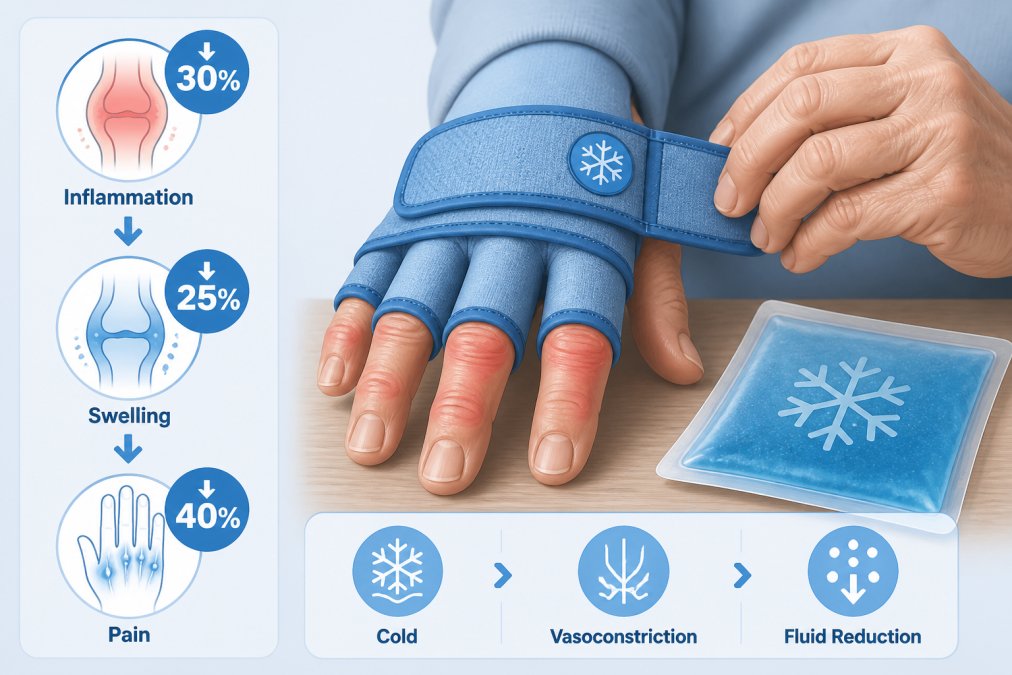
Cryotherapy also reduces the metabolic rate of cells in the affected tissue. During an inflammatory episode, cells release enzymes and compounds that damage cartilage over time. Cold slows this process, providing protective effects beyond immediate pain management.
According to the American College of Rheumatology's patient resources, cold application is particularly useful during acute arthritis flares to reduce swelling and provide short-term analgesic relief.
Cold Therapy for RA vs. OA: Does the Type of Arthritis Matter?
The type of arthritis you have changes which therapy you should default to.
Osteoarthritis (OA) is degenerative, producing chronic stiffness and aching that worsens with inactivity. OA patients typically benefit most from heat therapy in the morning to loosen stiff joints, with cold therapy reserved for days when a joint feels acutely inflamed or swollen after overuse.
Rheumatoid arthritis (RA) is an autoimmune condition causing systemic inflammation, often with warm, swollen, tender joints during flares. Cold therapy is generally more appropriate during active RA flares because the joint is already inflamed; adding heat would increase vasodilation and worsen swelling. Between flares, gentle heat can help with residual stiffness.
The practical rule: if the joint feels hot and swollen, reach for cold. If it feels stiff and achy without visible swelling, heat is more likely to help.
Best Cold Methods: Ice Packs, Gel Packs, and Compression Sleeves
Not all cold applications deliver the same result:
- Gel packs conform to the shape of joints better than rigid ice packs. Products like the TheraPearl Hot & Cold Therapy Pack use flexible bead technology that stays pliable even when frozen, making them practical for small joints like fingers and wrists.
- Ice packs are inexpensive and effective but don't conform well to irregular joint surfaces. Always wrap in a thin cloth, never apply directly to skin.
- Compression sleeves with cold therapy combine the vasoconstriction of cold with the edema-reducing effect of compression. Penguin Fingers' wearable cold compression sleeves are designed specifically for this purpose, with body-part-specific fits for fingers, wrists, and toes.
- Topical analgesics like menthol-based gels (such as Biofreeze) create a cooling sensation and provide temporary pain relief, but they don't lower actual tissue temperature the way a cold pack does. They're useful for on-the-go relief but shouldn't replace true cryotherapy for swelling management.
How Long to Ice Arthritis, and How Long to Apply Heat
Applying cold for too short a time doesn't lower tissue temperature enough to produce a therapeutic effect. Applying it for too long risks frostbite, especially in people with reduced skin sensitivity.
Cold therapy application guidelines:
- Apply for 15-20 minutes per session
- Allow at least 45-60 minutes between sessions before reapplying
- Never apply directly to bare skin, use a cloth barrier
- Stop immediately if the skin turns white, blue, or loses sensation
Heat therapy application guidelines:
- Apply for 15-20 minutes for warm soaks and heating pads
- Paraffin wax treatments can run up to 20 minutes
- Check skin every 5 minutes if you have reduced sensitivity in the hands
- Do not fall asleep with an electric heating pad in use
Short, repeated sessions are safer and more effective than one long application. Most people who don't get results from ice or heat are either applying it for too short a time or applying it inconsistently.
| Method | Duration Per Session | Sessions Per Day | Key Safety Check |
|---|---|---|---|
| Ice pack / gel pack | 15-20 minutes | 3-4 | Cloth barrier, check skin color |
| Cold compression sleeve | 15-20 minutes | 3-4 | Remove if numbness develops |
| Electric heating pad | 15-20 minutes | 2-3 | Auto shut-off, no sleep use |
| Warm water soak | 15-20 minutes | 2-3 | Water temp below 104°F |
| Paraffin wax | Up to 20 minutes | 1-2 | Test wax temp before dipping |
When to Use Cold vs Hot Therapy for Arthritis
Match the therapy to the current state of the joint, not to the diagnosis alone:
- Joint is stiff, achy, not swollen, worse in the morning → use heat
- Joint is swollen, warm, red, or inflamed after activity → use cold
- Joint is chronically stiff with occasional mild swelling → start with heat, switch to cold post-activity
Morning stiffness responds well to heat because joints have been immobile overnight. Evening pain after a day of activity often involves inflammation, making cold the better choice.
After Exercise: Post-Activity Recovery Protocols
Most people with arthritis reach for heat after activity because it feels comforting. This is wrong. Exercise creates micro-inflammation in joint tissues. Applying heat post-exercise increases vasodilation and can worsen swelling that's already developing.
The correct post-exercise protocol for arthritic joints:
- Cool down for 5-10 minutes with light movement
- Apply cold therapy to the most affected joints within 30 minutes of finishing activity
- Keep the cold pack on for 15-20 minutes
- Elevate the hands or feet above heart level if fingers or toes are affected
- Wait at least 2 hours before applying any heat
This protocol reduces next-day stiffness and slows cumulative inflammatory damage that repeated exercise can cause in arthritic joints.
Contrast Bath Therapy for Arthritis: Alternating Hot and Cold
Contrast bath therapy involves alternating between warm and cold water immersion, cycling through several rounds in a single session. The alternating vasodilation and vasoconstriction creates a pumping effect in the circulatory system, which accelerates fluid clearance from swollen tissues and improves blood circulation to the joint.
A standard contrast bath protocol for hands and fingers:
- Warm water soak: 3-4 minutes (92°F-100°F)
- Cold water soak: 1 minute (55°F-65°F)
- Repeat the cycle 3-5 times
- Always end on cold if swelling is present; end on warm if stiffness is the primary complaint
Contrast bath therapy works best for chronic conditions where both stiffness and mild swelling are present simultaneously. It's less appropriate during acute flare-ups when the joint is severely inflamed.
According to guidance from the American Physical Therapy Association on thermal modalities, contrast therapy is a recognized modality for managing chronic musculoskeletal conditions, though individual responses vary.
Safety Precautions for Heat and Cold Packs
Both heat and cold therapy are safe for most people with arthritis when applied correctly. Risks come from improper application: too long, too hot, too cold, or directly against compromised skin.
General safety rules for both therapies:
- Never apply heat or cold directly to bare skin without a cloth barrier
- Limit sessions to 20 minutes maximum
- Check the skin at 5-minute intervals during the first few sessions
- Do not use heat or cold over open wounds, stitches, or broken skin
- Consult a physician before starting thermal therapy if you have cardiovascular disease, diabetes, or peripheral vascular disease
Skin Sensitivity, Nerve Damage, and When to Stop
Reduced skin sensitivity is common in people with long-standing arthritis, diabetes, or peripheral neuropathy. If you can't reliably feel temperature changes in your fingers or toes, you're at higher risk of burns from heat and frostbite from cold.
If you have reduced sensation in the hands or feet:
- Use a thermometer to check water temperature rather than relying on feel
- Keep electric heating pad settings on low
- Set a timer for 10 minutes maximum and check the skin when it goes off
- Have someone else check the skin color if you can't feel it clearly
Stop treatment immediately and seek medical advice if:
- Skin turns red, blistered, or develops a rash after heat application
- Skin turns white, blue, or mottled after cold application
- Pain increases rather than decreases during or after treatment
- Numbness persists for more than 30 minutes after removing a cold pack
People with Raynaud's syndrome should avoid cold therapy on affected extremities entirely, as cold triggers arterial spasms in this condition.
Managing arthritis pain through thermal therapy takes consistency and the right application method. Generic flat ice packs and standard heating pads work reasonably well for large joints, but they fall short for fingers, wrists, and toes where precise fit and sustained contact matter. Penguin Fingers' wearable cold compression sleeves and dual hot/cold therapy wraps are designed specifically for small joints, with body-part-specific fits that maintain therapeutic contact during movement. PURCHASE Penguin Fingers and experience targeted relief that stays in place where you actually need it.
Frequently Asked Questions
Does arthritis feel better with heat or cold?
It depends on the situation. Heat therapy works best for chronic stiffness and tight joints, especially first thing in the morning when range of motion is limited. Cold therapy is more effective during an active flare-up, when joints are swollen, warm to the touch, or acutely inflamed. Many people with arthritis use both, choosing heat for daily stiffness and cold for flare-ups or post-activity swelling. Trying both and tracking which provides more relief for your specific symptoms is the most practical approach.
How long should you apply heat or ice to an arthritic joint?
For cold therapy, 15 to 20 minutes per session is the standard recommendation, with at least 45 minutes between applications to let the skin return to normal temperature. Heat sessions typically run 15 to 20 minutes as well, though moist heat like a warm bath can extend to 30 minutes comfortably. Never sleep with a heating pad or ice pack on a joint. Always place a thin cloth barrier between the pack and your skin to prevent burns or frostbite.
Can heat therapy make arthritis inflammation worse?
Yes, applying heat during an active flare-up can increase swelling and discomfort. Heat causes vasodilation, which draws more blood flow to the area. During acute inflammation, that increased circulation can amplify edema and pain. If a joint feels hot, looks red, or is visibly swollen, skip heat and use cold therapy instead. Heat is best reserved for stiff, achy joints that are not actively inflamed, such as morning stiffness in osteoarthritis.
Are there specific types of arthritis that respond better to cold therapy?
Rheumatoid arthritis (RA) flare-ups, which involve significant inflammation and joint heat, generally respond better to cold therapy. The numbing effect and vasoconstriction help reduce swelling and slow nerve conduction, easing acute pain. Osteoarthritis (OA), which tends to cause chronic stiffness without the same level of acute inflammation, often responds better to heat. Gout attacks, another inflammatory arthritis type, also typically benefit from cold therapy during active episodes to reduce swelling and pain.
What is contrast bath therapy and does it help arthritis?
Contrast bath therapy alternates between warm and cold water immersion, typically 3 to 4 minutes of warmth followed by 1 minute of cold, repeated three to four times. The alternating vasodilation and vasoconstriction is thought to improve circulation and reduce edema in the joints. It is commonly used for fingers, toes, and wrists. While evidence is still developing, many people with arthritis report reduced stiffness and improved range of motion after regular contrast bath sessions.
This article was written using GrandRanker


